‘Blitzscaling’ and the race to financial oblivion

This is a worthwhile overview of the indiscriminate capital flows that have drowned investment value and spiked capital risks in present stock and corporate debt markets.  Those holding equities, equity mutual funds and ETFs today are running in a perilous race that few comprehend.

Adam Neumann, the charismatic entrepreneur who led WeWork to become one of the world’s most valuable startups, stepped down as chief executive officer after a plan to take the company public hit a wall. Len Sherman, adjunct professor of business at Columbia Business School and former general partner of Accenture’s corporate venture capital fund, speaks with Bloomberg’s Lisa Abramowicz on “Bloomberg Money Undercover”. Here is a direct video link.

Posted in Main Page | Comments Off on ‘Blitzscaling’ and the race to financial oblivion

Seba update on the disruption of energy and transportation

This presentation was recorded in NYC October 29, 2019. Worth the 30 minutes.

The #CleanDisruption will be the fastest, deepest, most consequential disruption of energy and transportation in history. By analyzing and anticipating these disruptions, we can learn that the benefits to humanity will be immense, but to seize the upside, we will need to mitigate the downside.

Based on Seba’s #1 Amazon bestselling book “Clean Disruption” and Rethinking Transportation 2020-2030, this presentation lays out the key technologies (batteries, electric vehicles, autonomous vehicles), business model innovations (ride-hailing, transportation-as-a-service #TaaS), how the technology disruption will affect existing companies and sectors (market trauma) and how it will unfold over the next decade, as well as key implications for society, finance, industry, cities, and infrastructure.  Here is a direct video link.

Posted in Main Page | Comments Off on Seba update on the disruption of energy and transportation

Rate cuts aren’t bullish

The US Fed hopes that a 1.5% policy rate along with $60 billion a month in ongoing liquidity injections will be enough to keep stock markets afloat and avert a recession.  But monetary efforts work at a lag of many months, and a global downturn is already well underway.  An unprecedented decade-plus expansion of record debt and asset valuations have compounded financial risks from here.

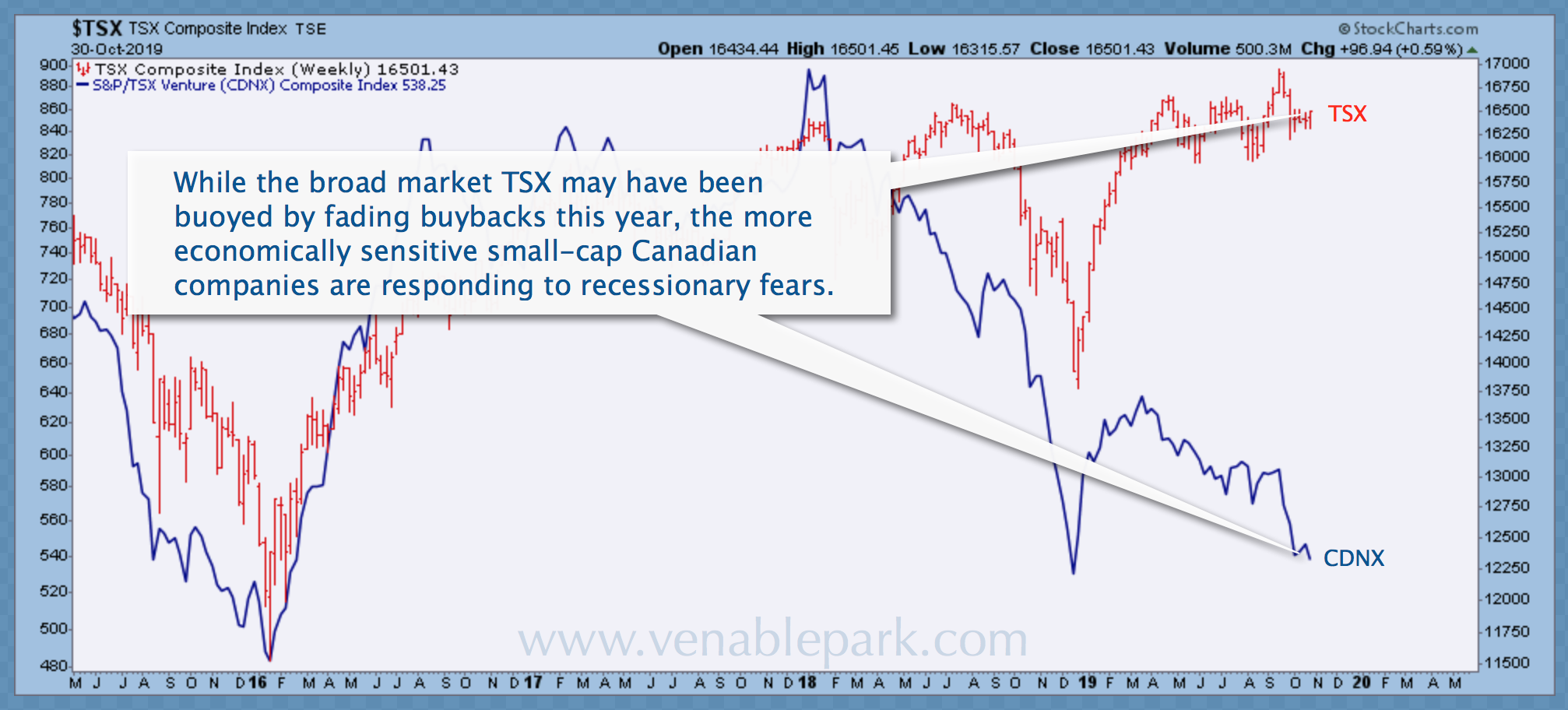
While borrowing to buy back their shares has been the main support for large-cap companies this cycle, it has not helped Canada’s TSX to advance even 5% over the last 5 years (in red below since 2015). The more economically sensitive index of small-cap Canadian companies (CDNX in blue), meanwhile, tells the trend of global demand with a 48% decline over the same period–and, so far, still falling.
A similar story is evident in the chart below of the Trump-tax cut-buyback-buoyed S&P 500 index (in red below) since 2015.  Big caps have bounced back from their 2018 sell-off (though only 7% made new highs this quarter), but the more economically sensitive US small-cap companies (Russell 2000 in blue), are back where they were in October 2017.
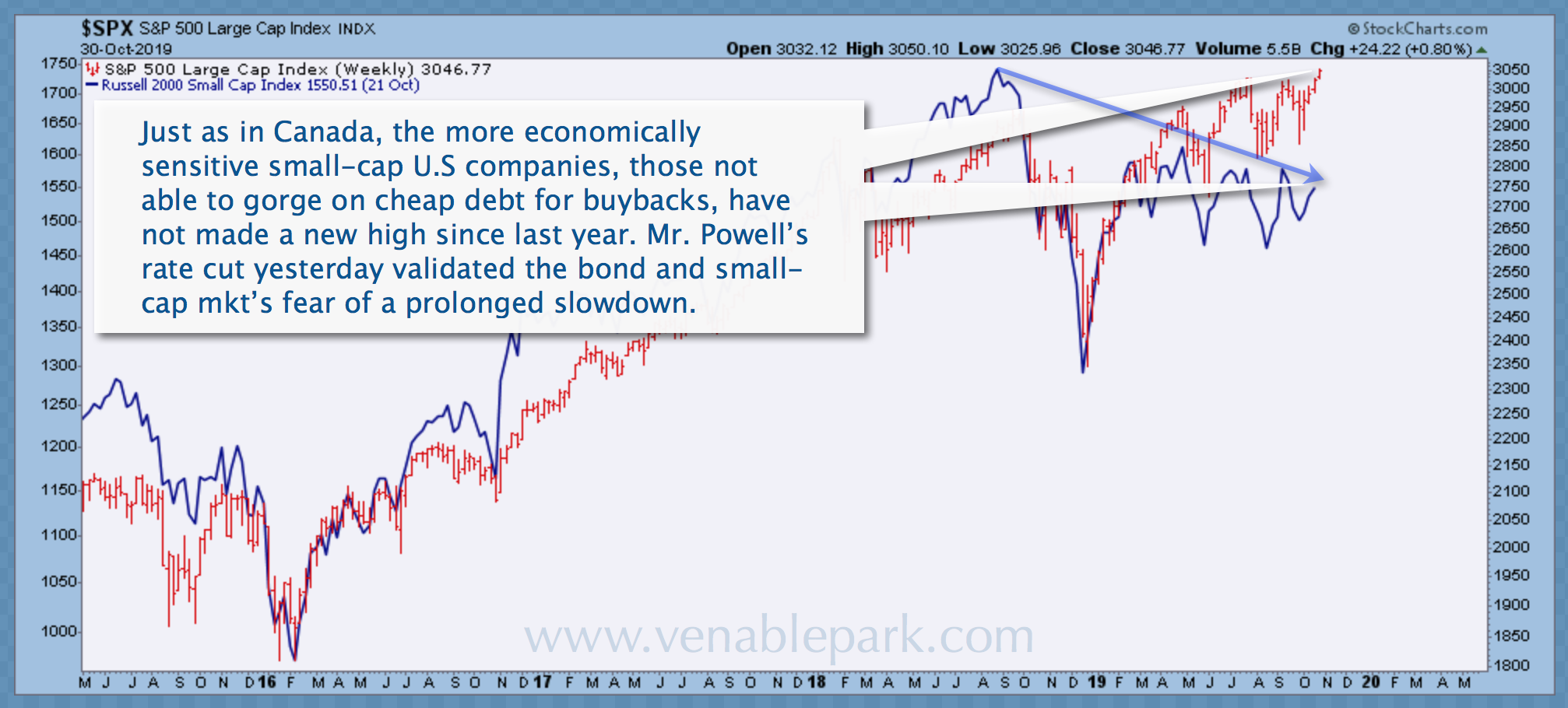
Importantly, with corporate debt today at harrowing highs, buyback plans have tumbled for 2020 along with executive optimism–not just for CEO’s, the majority of CFO’s surveyed think a recession will be underway within the next year and they’re looking to cut costs.

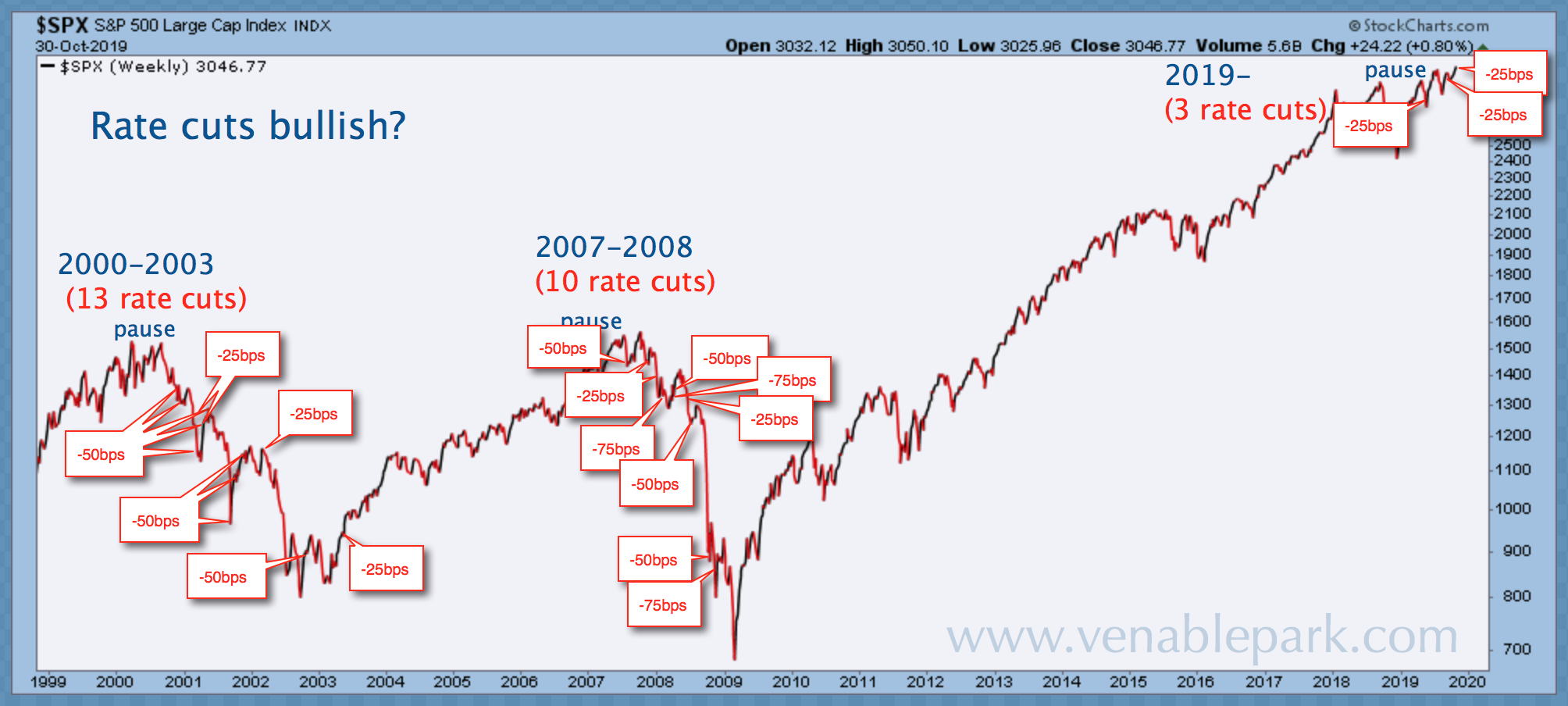
It’s wise to recall that rate-cutting cycles are a reaction to downturns, but they aren’t inoculation for the economy or financial markets.  As shown below, in my partner Cory Venable’s updated chart of the S&P 500 since 1999, rate cuts came fast and furious into the last recessions and still broad markets halved and small caps fared worse.  The case for a better outcome this time isn’t good.  Heads up.
Posted in Main Page | Comments Off on Rate cuts aren’t bullish