
Binge to bust: Fort McMurray’s warning to Canada

From 2001-08, financial speculation and a manic belief in insatiable demand helped oil prices leap six-fold and the economy of Fort McMurray, Alberta, boomed, with many knock-on effects through the broader Canadian economy.

After the bust, Fort McMurray residents have been paying the price for misplaced confidence, debt-fueled spending, and a backward-looking concentration on energy, transportation and infrastructure premised on fossil fuels.  See From binge to bust:  A Canadian oil town lines up at the food bank:

“Ten years ago, about 2,000 people came by every month for jars of peanut butter and cans of soup. Now, he and his staff help feed four times that. Before, the clientele was mostly folks struggling to pay rents that shot up during the oil boom. Today, it’s often men and women who were living high before the bust. Sometimes, they pull up in shiny pickups purchased just a year or two ago

…Fat paychecks and generous overtime earlier this decade fueled big spending on customized pickups and million-dollar homes. With work drying up, the bill has come due.

…Too many made a lifestyle based on an economy that wasn’t sustainable.”

Fort McMurray home prices have already fallen 44% since 2012, and consumer insolvency filings led national trends with a 39% increase in 2018.

The rest of Canada has been duly warned.  The sell crude and lever up household incomes with debt for destructive consumption is not a sustainable driver for the national economy. Meanwhile, we’ve fallen behind in innovation and investment in the products and services that are.  As explained by Eric Reguly on Saturday, Big oil blew it by not becoming big energy:

“…if Big Oil refuses to change, change will be thrust upon it.

…The direction of carbon taxes has only one way to go, and that’s up, which is really bad news for Big Oil and Big Coal. Activists like Ms. Thunberg have, in effect, given politicians the green light to make life more difficult for fossil fuel companies. Canada’s next government will find it hard to keep carbon taxes at inconsequential levels. BP had the right vision almost two decades ago with its “Beyond Petroleum” campaign. Too bad it had no stamina to see it through. If it had, it would be praised today. Instead it and its rivals are being demonized.

Still, it’s not too late for Canada to see the light and be the global evolution underway.  It’s happening with our without us; we might as well benefit than stagnate and suffer.  See Canada must focus its research to maintain its prosperity:

“Our leaders should be prepared to align our national values with a specific set of grand challenges – such as climate change, cancer, infectious disease and sustainable transportation – and focus our research on subsets of those, while there is still time.”

Two-thirds of the global population today live in a country where wind and solar power is already the cheapest form of new electricity capacity, see Rise of renewables may see off oil firms decades earlier than they think.  Forward-looking workers in the energy patch and related sectors are embracing the opportunity.  See Oil workers call for renewable energy training for just one example.  Also see America’s ‘Green Economy’ is now worth $1.4 trillion, about 7% of U.S. annual GDP and 16.5% of the green economy worldwide.

As engineer Mark Z. Jacobson at Stanford’s Solutions Project has been explaining for years now (watch this 2016 clip; the cost of renewables has fallen significantly more since then), Canada can transition to 100% renewable energy systems with critical cost savings, investment and job growth.  On the left, is the summary of how.  The blueprints have already been completed, and Mark is living in a house and driving a car that costs zero to power, and in fact, generates excess energy, which he sends to the grid each month. Canada can too:
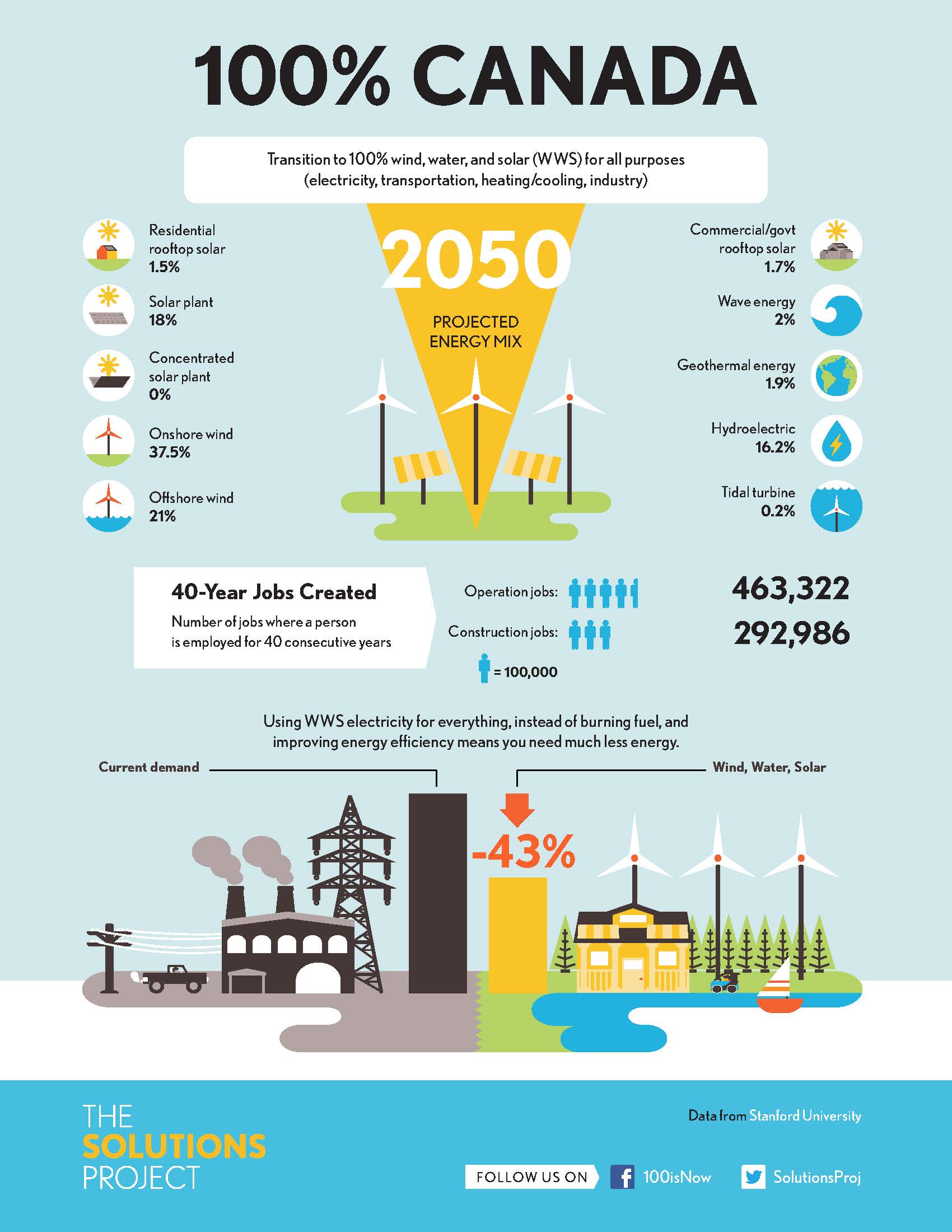
“Canada has a huge wind resource. You can power the country on its own with wind many times over…The cost of wind right now, in the United States, it’s the cheapest form of electric power by far….

“All new cars that are bought should be electric cars, all new homes should have electricity for everything… and for industry we need all new technologies to be electric.”   

Posted in Main Page | Comments Off on Binge to bust: Fort McMurray’s warning to Canada

Danielle’s bi-weekly market update

Danielle was a guest with Jim Goddard on Talkdigital Radio talking about recent developments in the world economy and markets. You can listen to an audio clip of the segment here.

Case in point:  to justify high fees as yields have fallen, mutual funds, like pensions have dramatically increased their risk exposure to try and ‘win’ lottery-like bets while they continue to tout ‘conservative’ strategies and fund names.  This drift has made their holdings less liquid and, as inflated prices mean revert, highly capital destructive.

See the WSJ:  Mutual Funds’ Embrace of High-Profile Unicorns Backfires. Looking to beat benchmarks, funds expanded their holdings of private tech startups only to mark down values after disappointing IPOs.

Posted in Main Page | Comments Off on Danielle’s bi-weekly market update

Fantasy planning yields financial disappointment

Each week I encounter nice people with deeply flawed retirement plans.  Many have been aided into misguided thinking by financial-sector marketing and salespeople, planners, even their accountants.  This is a problem because faulty assumptions in money management tend to end in a nightmare.  Working with sober return and withdrawal expectations is the best antidote, and that means facing facts as they are rather than as we wish them to be.  Appreciating that investment conditions have changed over the last 30 years is an important place to start.  Here’s a recap:

Principal secure, interest-bearing assets, with defined rates and maturity dates– bonds, bank deposit certificates and accounts–have long been acknowledged as the most appropriate place to build and hold savings for individuals.  Up until the early 1990s, they were also considered prudent for the bulk of funds held in pensions, insurance companies and other essential institutions too.  Payouts (liabilities) were provided by prescribed contributions, and the reinvestment of income payments received (the engine of compound growth).

In the 1980s, rates on government bonds and guaranteed investment certificates (GICs) in Canada averaged more than ten percent a year.  At 10% yields, one could withdraw or payout 5 or 6% a year in retirement and still leave 5 or 4% for reinvestment and compound growth.  This allowed withdrawals to rise with the cost of living and not rapidly evaporate the principal.

In the 1990s, as rates moved lower,  the same deposits now averaged just over seven percent a year.  At that point, one could withdraw 5% annually in retirement and have a percent or two for fees and reinvestment (growth).

In the 2001 recession, central banks slashed base rates and government bonds, and GICs fell below five percent.  By 2007, heading into the great recession, rates were less than four.  A decade later, in 2017, the same assets were paying less than one percent.

By 2018, interest rates managed to move higher, and investment-grade notes yielded nearly 3%, before falling over the last year to two percent and less.

Notwithstanding present yields, most pension and individual retirement plans are still assuming compound returns in the 5 to 7% a year range, and calling their assumptions ‘conservative’.

Wanting this dream, many have thrown safety to the wind and moved into principal-insecure equities and high-risk corporate debt (or funds and ETFs) where income may be 3 or 4% a year, and the next bear market is likely to knock 20 to 70% off current prices (100% should an individual issuer go bankrupt).  Also, unlike interest payments that are contractually prescribed on bonds, dividends on equities can be cut at any time, when a company needs to.

This shift into high-risk assets has happened even where the owners cannot afford to lose money, nor spend years after that hoping to grow it back.

Also, those now holding risk and hoping to collect 3 or 4% a year in income are typically paying a percent or three in annual fees on these accounts (hidden and not) while still hoping to withdraw 4 to 6% a year in retirement.  This math doesn’t follow!  Rational savers cannot afford to pretend that it will.

For most individuals, a wise course is to continue controlling risk and preserving liquidity–keep doing the right thing to protect capital.  Steer clear of highly over-valued equity and corporate bonds, and stick with the most secure deposits even at low rates. Reinvest income and postpone withdrawals to not start before our mid-60’s where possible.

If income withdrawals are needed now, they should be no more than 2% a year in present conditions, unless you plan to erode principal.  Yes, 4 and 5% withdrawals used to be possible, but as I’ve explained above, they are no longer reality.  Tell your loved ones.  If your advisor is still telling you that they are, find a new one.

If 5%+ income withdrawals are necessary, annuities that can guarantee such payments for life may be an option for some, but you do give up claim on the principal to buy them.

For those who can keep financially disciplined in this environment, better yields lie ahead once equity and corporate debt markets fall into the next bear market.  At that point, bargains are destined to be plentiful, and risk-assets investment-grade once more.  But first, you need to get from here to there, very carefully.

Posted in Main Page | Comments Off on Fantasy planning yields financial disappointment




