
As financial markets hope for more magic from ‘Wizard of OZ’ central bankers, some of us remember how that story ends.
Gene Frieda, global strategist at Pimco, discusses Federal Reserve policy and the U.S. economy. Here is a direct video link.
As financial markets hope for more magic from ‘Wizard of OZ’ central bankers, some of us remember how that story ends.
Gene Frieda, global strategist at Pimco, discusses Federal Reserve policy and the U.S. economy. Here is a direct video link.
Andrew Coyne points out some startling figures about the Canada Pension Plan on which the majority of Canadians depend for retirement income. See Canada Pension Plan gets lucky with active management, for now. Here are some key takeaways:
As always, there’s no free lunch. The plan’s high risk-exposure also sets it up for higher than market losses in the next downturn, just as more and more retirees are applying for pensions, and fewer workers are paying into the fund. The critical importance of stable pensions and reliable payouts was the very reason that some 96% of public pension assets were held in fixed-income bonds and cash into the 1950’s, with strict limits on the amount of risky bets permitted (Federal Reserve’s US Financial Accounts).
As I’ve pointed out in the past, the fact that one may win at gambling for a given period does not make it a legitimate or prudent investment strategy. Coyne comes to a similar analogy:
“Suppose, as an alternative scenario, the CPPIB’s managers had bet the fund on the fifth race at Woodbine, and suppose their their horse had won. It wouldn’t mean either that betting on the horses was a good investment, or that the CPPIB knew how to pick horses. It would just mean they got lucky…
Will it still be ahead of the game 13 years from now? We shall see. But by then the money will have been spent, and the managers paid, and it will be too late to ask for it back.”
High operating costs and risks do not bode well for the Canada Pension Plan’s promise to an aging, under-saved population; nor for Canadian taxpayers and a consumption-driven economy. It will no doubt need restructuring to defer retirement ages by several years as well as increase funding in the years ahead. All will be difficult for Canadians to afford.
Who in the world has been buying stocks at increasingly speculative-grade valuations over the past five years? As charted below, the biggest net buyers have been public corporations themselves as manageme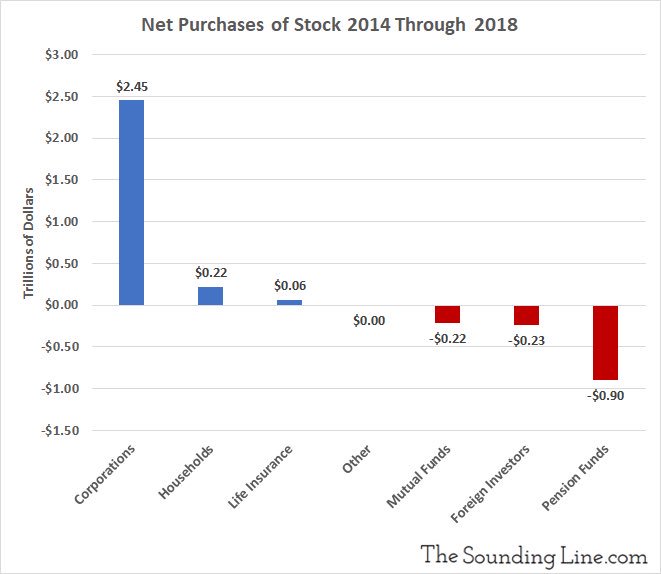 nt used liquidity driven by central banks to buy back shares and drive their prices higher.
Not only has the activity fabricated the majority of paper earning gains and diverted funds from critical areas like operations, R&D and capital investment, but many companies have borrowed heavily to do so, and thus depleted their strength and opportunity fund for meaningful investment in the years ahead. There is a reason that corporate earnings are a historically mean-reverting series; this time will not be different.
It’s been a lucrative short-term strategy for executives who have sold their personal holdings into the flow created. But it’s also a blatant conflict of interest in their duty to broader company stakeholders like employees, creditors and others counting on the viability and sustainability of the company’s operations longer-term.
As share prices plunge, and profits retreat in the downturn, the folly of so much wasted capital will be widely evident once more. Individuals and pensions that have been riding corporate buyback flows, through increasing equity exposure, and confusing rising prices with investment acumen in recent years, are also due for a harsh awakening.









