Impossible-to-repay loans are not legitimate financial services

As I explained in The indefensible predatory business of payday loans, criminal interest rate caps stood for many years in both Canada and the United States at 60%. The financial lobby had governments carve out workarounds in the last decade, and impossible-to-repay rates–often compounding to several hundred present annualized–have enabled credit enslavement to go mainstream since.

Capping lending rates will not eliminate loan sharks but it will help de-legitimize the activity and take it off of main streets where many are now masquerading as respectable financial service firms.  As I observed in the past:

We will not be able to rebuild financial strength and stability in society and the crucial middle class until we stop letting financial predators strip-mine vulnerable people and leave social wreckage for taxpayers to underwrite.

Two so called ‘far-left’ US democrats have now proposed a bill aimed at capping lending rates.  This issue should not fall along partisan lines though, it’s about ethics and what kind of businesses a civil society wishes to propagate and subsidize with finite public resources.  Former savings and loan crisis prosecutor Bill Black offers further perspective on the topic in the following clip.

They call it Loan Shark Prevention, which would allow post offices to act as banks for poor working people, but credit companies claim it will hurt the poor. Here is a direct video link.

The classic lender-lobby argument against re-capping loan rates is articulated here. To wit (with some parenthetical comments from me):

“While annualized interest rates on payday loans look very high, one must keep in mind that the term of these loans is short, typically two weeks”.

[DP: Initial 2 week periods typically roll over into consecutive terms with additional fees that quickly snowball into impossible to pay sums.  We might as well bring back debtor’s prisons that imprison people indefinitely.  At least physical incarceration was visible to the public, as debtors were fed and housed on the taxpayer’s tab at the bidding of lenders who had made bad loans].

“Furthermore, payday loans are better than illegal alternatives that can result in higher rates or even criminal behavior. Yet, a 15% cap would make it impossible for most of these credit-constrained Americans to get credit through payday loans or other means”.

[DP:  Giving people loans they cannot reasonably repay is not helping them.]
Posted in Main Page | Comments Off on Impossible-to-repay loans are not legitimate financial services

Straight Talk on Your Money

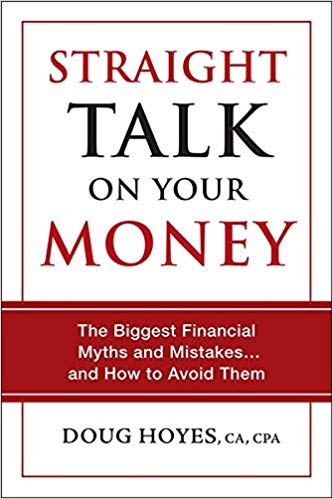
Yesterday I recorded a podcast with insolvency trustee Doug Hoyes, co-founder of one of Canada’s largest personal insolvency firms.  Last night I read his 2017 book Straight Talk on Your Money — the Biggest Financial Myths and Mistakes and How to Avoid Them.

Doug’s book should be part of school curriculums and required reading for anyone trying to establish good money management habits. Those who can understand and adopt the practical insights offered can avoid the common financial errors which are so widely prevalent today.  Doug writes in an engaging, easy to read style full of real-life stories witnessed over 30 years as a chartered accountant and debt restructuring expert.

I have often observed that my early years as a litigation lawyer were invaluable in showing me first hand all the things that can go wrong with human relationships, businesses and money.  Strong financial and life management is more about what not to do than most people appreciate.  In the push to sell/buy financial products, many miss the critical foundation blocks and go straight to a focus on window dressing.

Sustainable strength is built from personal discipline and daily choices that minimize waste and balance life’s many risks.   Doug’s book can help to refocus thinking and habits for a higher probability of stability and attaining individual goals.  Doug’s blog and Debt-free in 30 podcasts also offer practical, valuable insights, and they are free.

I will post a video link to our discussion when it’s published in early June.

Posted in Main Page | Comments Off on Straight Talk on Your Money

Quantifying ‘wealthy’ and the capital value of income streams

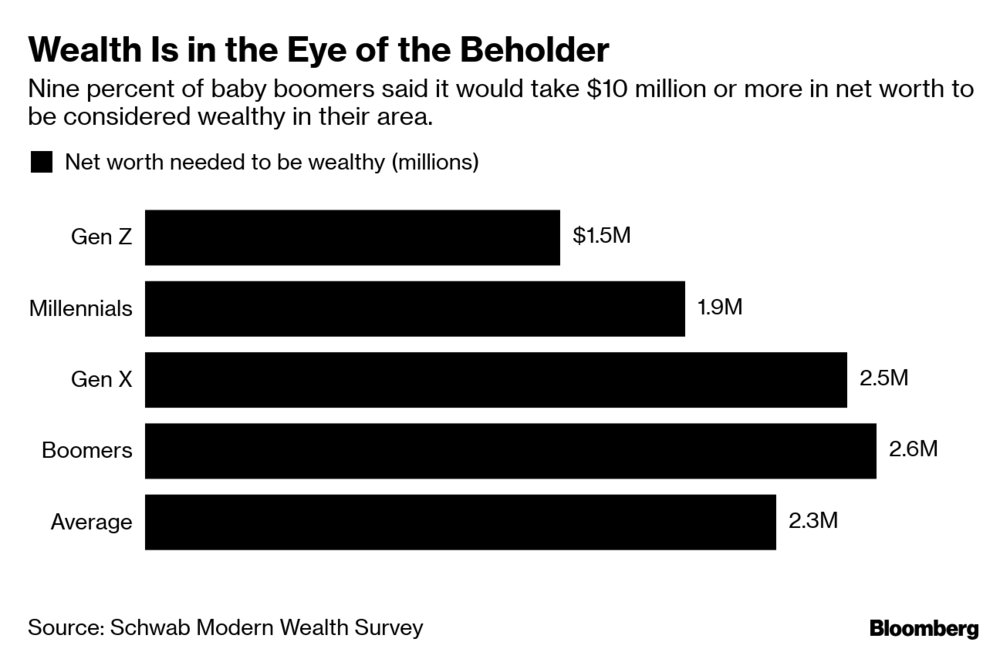
A recent Charles Schwab study asked different age groups to estimate the net worth needed to feel ‘wealthy’ where they live.  Not surprisingly, the amount estimated was higher for those aged 50+ than those in their 20’s–older folks tend to have more carrying costs and obligations.  See:  How much money do you need to be wealthy in America?  But all age groups tend to dramatically underestimate the capital value needed.

As charted below, those age 14 to 24 (Gen Z) estimated net worth (including one’s home) of 1.5 million U$ made one wealthy, while those aged 24 to 38 (Millenials) guessed $1.9 m was needed.  Gen X (those 39 to 53) and Boomers (54 to 73) estimated $2.5-2.6m was the magic number.

Meanwhile, the average household income in the US today is about $60k a year, and $C 70k a year in Canada.  If the average household were to stop working and replace that same level of income from interest earned on capital-secure deposits today (paying 2.5% and less), one would need–outside of any home equity–at least $C 2.8m in Canada, and $U 2.4 m in America.  And yet, few households earning 60 to 70k a year in pre-tax income today would think of themselves as wealthy.

Other studies report that half of the people over age 55 in North America have zero savings for retirement, and the half that does has a median amount of $104,000.  One hundred and four thousand will produce a retirement income of about $2,600 a year.

Ten percent of those over age 50 have a defined benefit pension plan from their work.  This fortunate group also tends to dramatically underestimate the capital value of it.  When I ask people if they or their spouse have a pension, it is common for them to dismiss it as ‘just 30k a year’ or whatever the number.  When I point out that a guaranteed income of 30k a year is like having 1.2 m in savings today, most are surprised.  At the same time, the maximum US old age security income of 34k a year, and maximum CPP and OAS in Canada of 21k a year, also have large capitalized values of about 1.3m and 840k respectively.

Under-estimating the capital needed to reliably produce retirement income has resulted in widespread saving shortfalls over the past two decades.  Trying to fix deficits with higher and higher-risk capital bets has the overwhelming probability of making shortfalls larger over time–and this is precisely what’s happened.

Financial/life plans that assume attainable yields along with pragmatic saving and withdrawal targets have a much higher probability of meeting our goals and needs. The sooner we accept and adopt honest math the better.

Posted in Main Page | Comments Off on Quantifying ‘wealthy’ and the capital value of income streams