Canadian economy gearing down in 2019

This morning, the Bank of Canada maintained its overnight rate at 1.75%, below what it deems the neutral range, on broad-based evidence that the Canadian economy will weaken further from its lacklustre 2018 growth rate (1.8%) during the first half of 2019. Although the BOC’s decision was widely anticipated, the loonie is selling off against the U$ after the announcement.

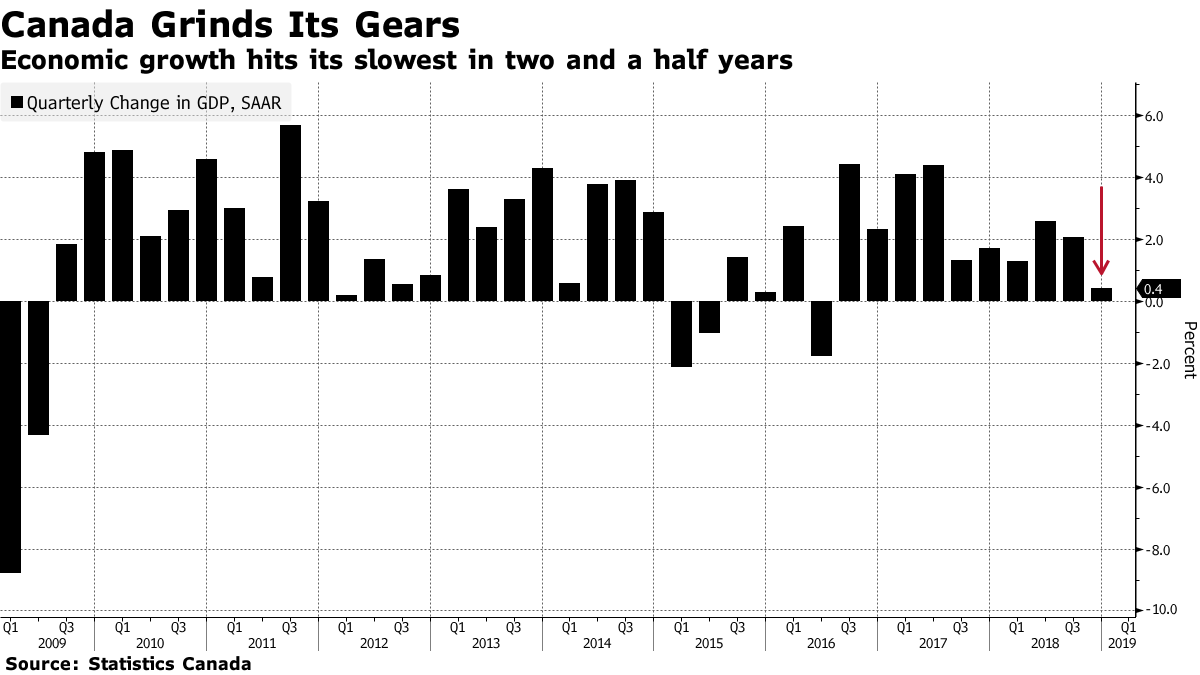
According to Statcan’s latest estimate last week, the Canadian economy grew by just 0.1% in the last quarter of 2018–an annualized rate of 0.4% well below the Bank of Canada’s expectations. Weakness was across the board: consumer spending expanded at the slowest pace in nearly 4 years (0.7% annualized), housing investment fell 14.7% (the most in 10 years), business spending 10.9%, and real final domestic demand fell 1.5%, after a 0.5% contraction in Q3. As Economist David Rosenberg pointed out this week, back-to-back quarterly declines in this measure have always been associated with official recessions.
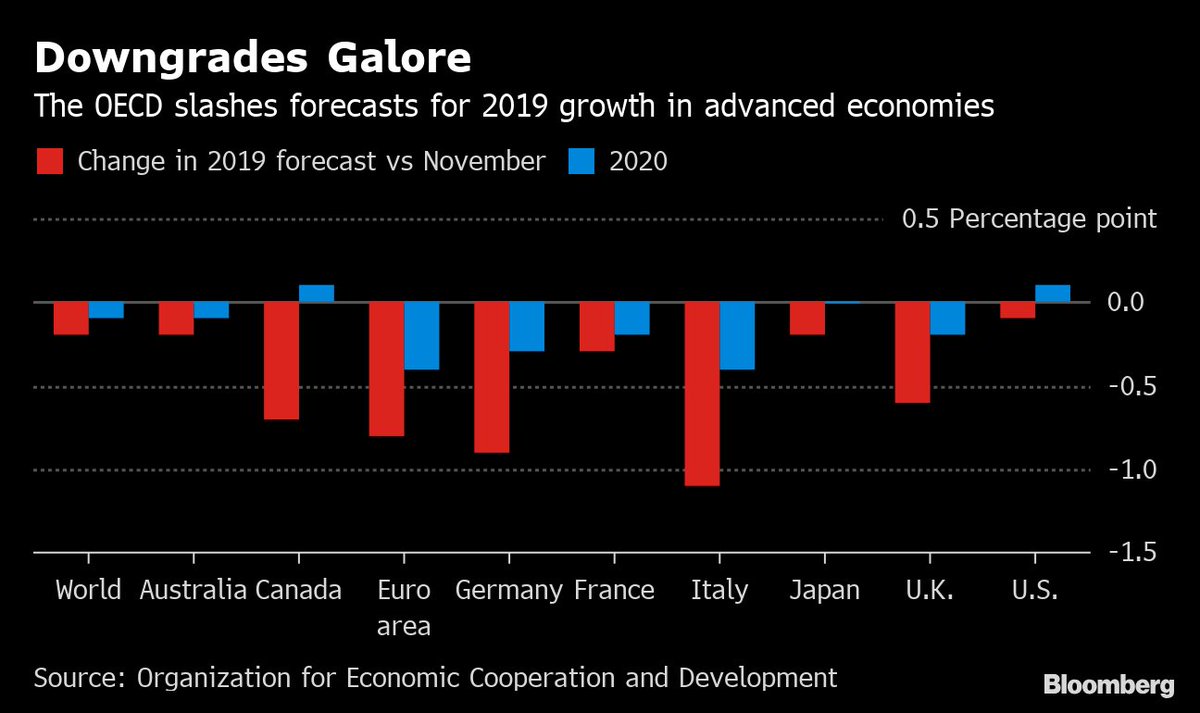
Of course, economic weakness is not just showing up in Canada; the OECD downgraded its growth forecasts for advanced economies further this week for 2019 (below in red) and 2020 (in blue).
Downturns are a normal recurring part of every economic cycle, and a decade since the last recession no one should be shocked that weakness has returned. Unfortunately, with households and corporations holding record debt and low liquid savings, along with falling oil and realty prices, Canada has never been less prepared to weather the financial challenges now spreading.


Posted in Main Page | Comments Off on Canadian economy gearing down in 2019

Destructive policies and the downturn debt has amplified

Individuals, institutions and corporate insiders have been net sellers of stocks in 2019 even as corporations, directed by those insiders, continue to buy back shares and pile on debt to do so.  See Stock buybacks top Capex for the first time since 2008 and This stock market rally has everything but investors:

The surge in buybacks reflects a fundamental shift in how the market is operating, cementing the position of corporations as the single largest source of demand for American stocks. The binge has helped sustain a bull market approaching its 10th birthday, even in the face of political, international and economic uncertainty.

Meanwhile, financial stress is predictably rising on higher rates, record debt and falling revenues.  See  Investors urge debt bloated US companies to shape up:

“Growing debt piles have fed fears among investors that if companies do not start to get a grip on their borrowing, worsening economic conditions could imperil their ability to fund themselves. That could potentially send credit ratings even lower, into the junkyard of “high yield”.

A global survey of investors carried out recently by Bank of America Merrill Lynch found that 50 per cent of respondents would rather see companies using their cash to mend balance sheets than spending it on plants or equipment, or returning it via buybacks or dividends. That was the highest percentage since September 2009.”

After enabling this destructive chapter with near-zero rates for a decade and trillions in QE liquidity funnelled into buybacks and bubbles, now central bankers are saying they have to pause in normalizing rates out of concern for the fragility of corporate balance sheets!!  And yet, maintaining the status quo will only make the problems at hand grow even bigger.  See Fed’s Kaplan says U.S. corporate debt a reason for rate-hike pause:

“A $5.7 trillion borrowing binge by U.S. companies could make a slowdown in the world’s biggest economy even more painful and is one more reason the Federal Reserve was wise to put interest rate hikes on hold, Robert Kaplan, president of the Dallas Fed, said…

Companies with big debt loads may be more likely to cut spending and hiring in a downturn, “and the danger is that with a sufficient enough slowing, you’ll have a greater deterioration in credit quality than you would otherwise, which could in turn amplify the slowdown,” Kaplan said.”

The dots are obvious to connect here:  easy credit is the cause, not the fix.  Only higher rates, tighter lending, insolvencies, break-ups, restructuring, write-offs and deserved financial pain will finally right and restart our economy on more stable footings.

Continuing to enable dumb, reckless and criminal actors can only perpetuate more of the same, along with more waste and cost, for even longer.


Posted in Main Page | Comments Off on Destructive policies and the downturn debt has amplified

The Current examines the struggle of adult ADHD

A deficit in the executive function of the brain or ‘attention deficit disorder’ is a challenge in varying degrees for many people.  Some can achieve their goals and training notwithstanding, others drop out of education and give up on dreams because they are not able to meet requirements, or are told they’re not trying hard enough or not cut out for school.  Lost productivity can be a life-long consequence.

New studies find that adults with ADHD tend to have more health problems and shorter life-expectancy.  Many struggle with addiction, relationship problems and frustration throughout their life.  It’s an affliction that can run in families and something which I have witnessed up close in my own. There is a lot of stigma and ignorance around this condition, including in the medical profession.  Worse, many parents that go undiagnosed or untreated are then unable or unaware of how to help their children when they present similar symptoms.  Early diagnosis is best, but it’s never too late to seek help.  On the upside, studies show that some tasks can benefit from The Creativity of ADHD.


Recent studies also show that cardiovascular exercise gives a boost to the brain’s executive function, and the improvements were particularly noted in men, see Exercise gives older men a better brain boost:

This pattern of connectivity was more robust in the women and has been positively associated with executive function, which are skills that contribute to being able to focus, pay attention and manage time. Fitness levels, however, were more strongly associated with improving this brain efficiency pattern for men than women.

Posted in Main Page | Comments Off on The Current examines the struggle of adult ADHD