Financial sales force continues to resist duty of care

The US Labor Department’s rule requiring a fiduciary standard of care from advisors giving retirement advice was quashed last summer, and no federal efforts on this critical front have since materialized.  The industry-friendly SEC meanwhile put forward a watered-down Reg BI ‘Best Interest’ standard that allows conflicts of interest to remain largely intact.  Not surprisingly, the North American Securities Administrators Association (NASAA) has commented in favour of the SEC proposal, while the Investment Adviser Association, representing federally registered advisors who are already subject to a fiduciary standard under the Investment Advisers Act, have pointed out that the BI standard will allow the conflicted advice broker/dealers provide to continue.

In response, states like Maryland, New Jersey and Nevada are advancing proposals for a state level fiduciary standard for broker-dealers and financial advisors, and industry associations are working hard to push back.  See Nevada, Maryland and New Jersey push fiduciary proposal.

The insistence on a fiduciary standard in financial advising is not going way.  Two decades of allowing the sales force to put their profits ahead of the best interests of their clients have undermined the strength and stability of families, companies and governments alike. We all continue to pay the price for undersaved populations engaged in speculative products and activities ending in losses they cannot afford.

Many clients and financial sales representatives remain blind to the difference here, for more see What makes a financial advisor a “true” fiduciary:

“Ultimately, a fiduciary operates without conflict and with one driving force: the clients’ best interests. As this sentiment amongst advisors grows, it will continue to serve as one of the most significant catalysts for migration to the independent space…

When we look at those who are breaking away and forming their own firms, we recognize that they’re making a fundamental change from being an employee to being a business owner, from being a broker to being a fiduciary advisor and from being a product advocate to being a client advocate.”

The ability to prioritize the clients’ best interests without limitation was the reason that my partner and I left a bank-owned broker/dealer in 2003 to found Venable Park Investment Counsel Inc.

As in 2000-03 and 2007-09, the next bear market will once more highlight the contrast between fiduciary advisors/managers and the salesforce.  Once losses hit, sales firms are always the first to point out they’re not fiduciaries, and that clients bear responsibility for their own capital losses.

 

Posted in Main Page | Comments Off on Financial sales force continues to resist duty of care

After the boom: the future of Australia’s housing market

Buying at irrational levels on the belief that prices can only go up is the definition of speculation, not investing, and financial pain in speculation are the norm not the exception.  There are familiar themes in this story for Canada today, as well as the 2006-2012 US and Ireland housing busts.

For years now the real estate discussion has been all about rising house prices in Sydney and Melbourne and how hard it is to buy a house or find an affordable rental. But not any more.  Here is a direct video link.

Housing and banking expert Martin North North has criticised developers and the housing industry for “throwing up” high-rise buildings at such alarmingly fast rates. He warned viewers that significant defects and safety concerns are imminent.  Here is a direct video link.

Posted in Main Page | Comments Off on After the boom: the future of Australia’s housing market

The upside inherent in bear markets

John Hussman does an excellent job this month in highlighting how richly-valued stock prices compare with the central bank’s much smaller ‘put’ power in Ground Rules of Existence:

One has to remember that the current market capitalization of U.S. corporate equities now stands at $40 trillion, twice the level of U.S. Gross Domestic Product – the highest multiple in history (the multiple peaked at 1.9 in 2000). Investors are vastly overestimating the effectiveness of monetary policy if they believe that the Federal Reserve buying a few trillion in Treasury bonds can reliably stop “sudden efforts at escape” among investors holding $40 trillion in securities that the Fed cannot buy, and that even the U.S. government could not buy without a vote by Congress to effectively nationalize U.S. corporations.

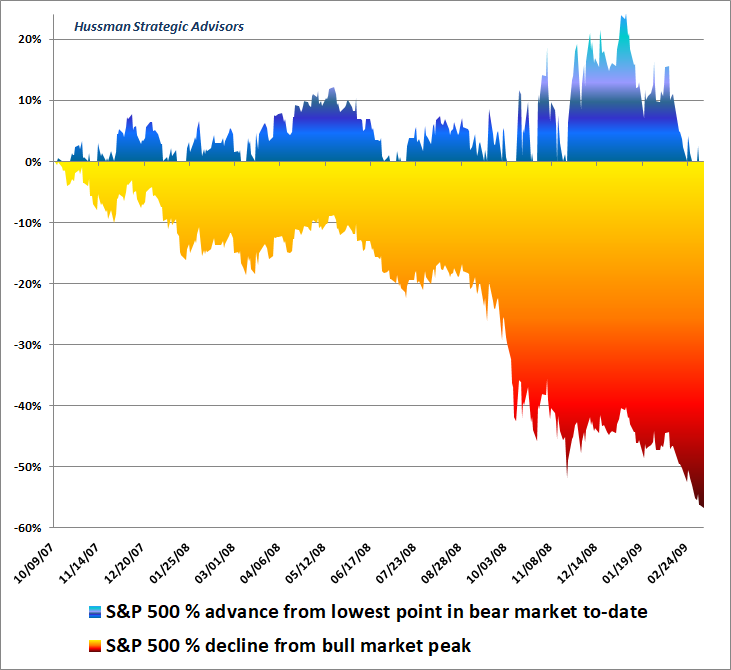
He also includes three vivid charts showing the intermittent rallies (in blue) within the overall bear market declines (yellow to red) of the 2007-09, 2000-03 and 1929-32 cycles, which are our present cycle’s closest historical relatives.  Below is the 2007-09 chart along with Hussman’s reminder of the upside coming for value-conscious buyers who can stand clear of falling assets and then buy once the bear market restores investment-worthy prices in the months ahead.

“In summary…we expect dismal consequences for the U.S. stock market over the completion of this cycle, and over the coming 10-12 years [for those holding stocks at present levels]. Yet the historical reality is that once speculation shifts to risk-aversion, a period of just 18-30 months is typically required for valuations to revert to average or below-average levels, creating fresh opportunity for value-conscious long-term investors.”

Posted in Main Page | Comments Off on The upside inherent in bear markets