
Canadian mortgage growth slowing: good for households, bad for banks

Good news, Canadian mortgage growth is finally coming off the frenzied boil of recent years. As shown below, according to the Bank of Canada, Canadian residential mortgage growth rose 3.1% year over year in December to $1.55 trillion, the slowest pace since May 2001, and half the growth rate of two years ago.  Canadian households need time to heal their fragile finances and piling on debt at a slower rate is a critical step. Paying it down and writing some off in bankruptcy is next.  See Canadian banks on notice with mortgage growth at 17-year lows.
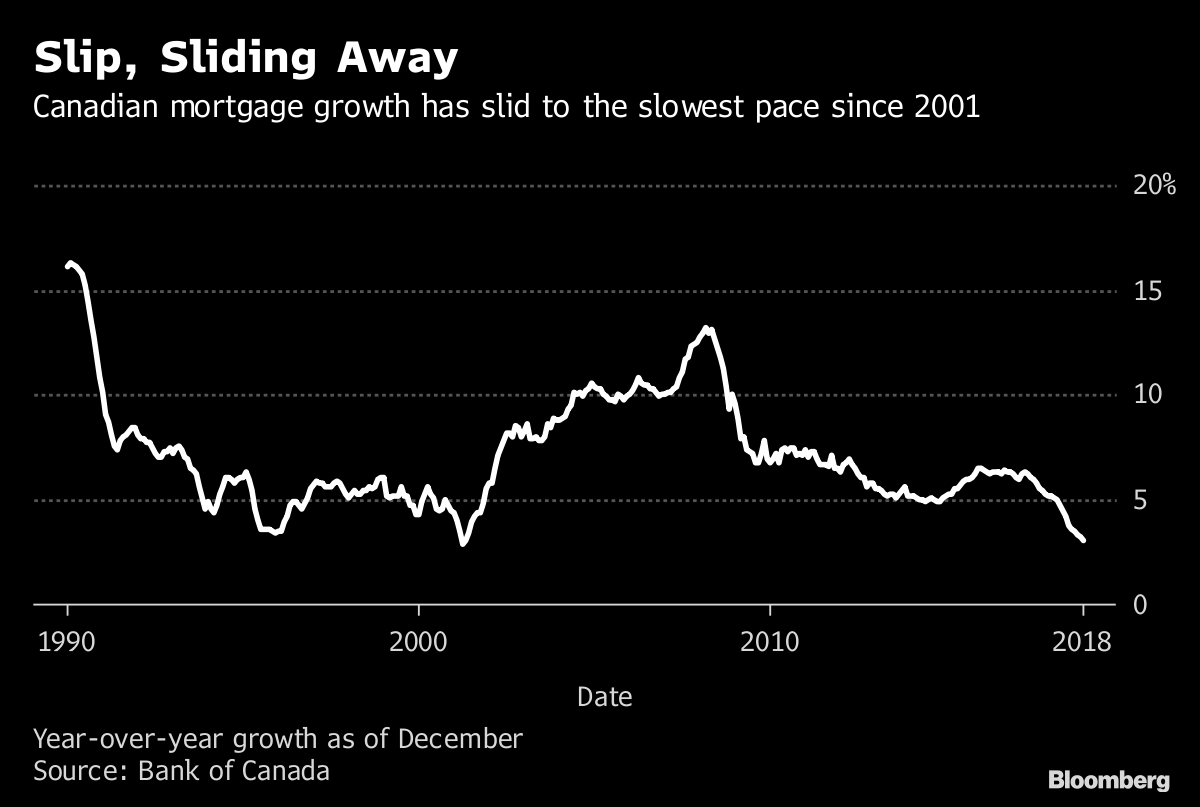
It’s not so great for Canadian lenders and investors, however, as mortgages have been a mainstay of profits.  Moreover, financial companies make up more than a third of the Canadian (TSX) broad market index, and many funds and managers are designed to track it through bull and bear markets.

As the oligopoly lenders of first resort, Canadian banks are naturally levered on Canada’s economic/credit cycle.  But even in the 2000-02 decline, when Canadians were less indebted, and the economy managed to avoid joining the US in an official recession, Canadian banks lost half of their value and led the overall TSX to match them in the drubbing.

To fill the mortgage-profits void, Canada’s six biggest banks increased their commercial lending last year by 11%, even as Canadian corporations were already the most indebted in many years (see Heap of Junk) and their revenue and profit cycle due for disappointment.

All of this has served to attract even more international attention from short sellers betting that Canada’s banks are overdue for their next cyclical repricing.  See:  Short sellers renew bets against Canadian banks in 2019.  If past is prologue, the ‘correction’ this time could easily be 50% from the 2018 share price peaks, and short sellers will be richly rewarded for their patience.

Unfortunately, most Canadians are today holding the ‘long’ side of this trade on the mistaken belief that bank shares are ‘defensive’ and the broad Canadian stock market is well diversified.  Following ten years of the largest credit orgy in Canadian history, they’re anything but.  It’s no consolation, but Australian bank investors face similar downside for similar reasons, see Australian banks have more than reputations to worry about. The songs remain the same.


Posted in Main Page | Comments Off on Canadian mortgage growth slowing: good for households, bad for banks

Bayer-Monsanto monopoly approval requires public outrage

The US Department of Justice finalized its approval of the Bayer and Monsanto merger. A new monopoly will be created over agricultural pesticides and industrial seed production, with farmers locked into industrial farming and our health endangered. Here is a direct video link.

Posted in Main Page | Comments Off on Bayer-Monsanto monopoly approval requires public outrage

Real estate engine running out of steam–for good reason

Sales trends lead price trends, and according to a new report by Altus Group on behalf of the Canadian Real Estate Association, Canadian home sales fell 11% nationally in 2018 on poor affordability, higher rates and tougher loan qualification rules.  The report also estimates that each home sale not made is a loss of some $60,000 in knock-off revenues not flowing through the economy to related services like lawyers, realtors, movers, home furnishings etc.  See:  Sales decline causes significant economic spin-off losses.

Naturally, these are the same ‘feeder fish’ sectors that grew above trend over the last decade and are now feverishly lobbying the government to step in with more ‘help for homebuyers’  in the form of 30-year mortgage amortizations and laxer lending standards (help for whom?).

While slacker conditions may enable a few more people to hyperextend themselves a little further in debt servitude and realty speculation, it will not help what ails Canadian households and our overly-concentrated-on-realty economy.

The real estate gravy train had a hell of a run over the past 15 years on lower and lower rates, higher and higher debt, and inflows of foreign capital looking for land banks; but all credit booms must come to an end, and this one is long overdue.

As in past periods of ‘easy money,’ it is typical for individuals and institutions to ramp up their expenditures, leverage and risk exposure during the boom times and then be caught short when money flows recede.  On the other hand, those who well managed the last decade of ultra-low-rates and rising prices will have taken the opportunity to pay down debt, reduce financial leverage, and strengthen their balance sheets with liquid savings. They will have reduced costs, not increased them. They will not have their income and assets all dependent on a never-ending expansion. They will have a plan that defines their life and financial goals including a target list with the amount they wish to allocate to different asset classes once price and yield come back to attractive levels.  They will, in short, be some of the few positioned to benefit as this historic financial cycle completes.

Posted in Main Page | Comments Off on Real estate engine running out of steam–for good reason



