The truth about jellybeans

Ok, time for a refresher on financial basics 101:  The vast majority of finance and advice/management firms are designed to collect the highest fees on capital allocated to the highest-risk asset classes and products; hence the business model is to keep people long the highest-fee asset classes at all times.  This is the case even when risk-reward prospects are bleak.  The most they will offer is to suggest a ‘rotation’ out of one risky asset to another or an ‘underweight’ in one to ‘overweight’ another.

Also, because nearly all business and market news media are sponsored by these same companies, their representatives are the ubiquitous source of nearly all financial commentary the world over; it’s not insight or advice, it’s their sales pitch.  Hence, why it is so rare to witness honest comments on meaningful risk management anywhere.

An exception slipped through yesterday in the person of Investec Asset Management Ltd.’s Philip Saunders, who is quoted on Bloomberg as follows:

“If U.S. equities have a tough time, do you honestly believe that you should be switching out of U.S. equities and go into other markets because they are going to have different experiences? They are in the same boat.”

The article goes on to include the chart below which compares the last three major loss cycles in 1998, 2000 and 2008 as between US (in black) and Asia Pacific equity markets (in pink). Does this look like global diversification is a benefit?
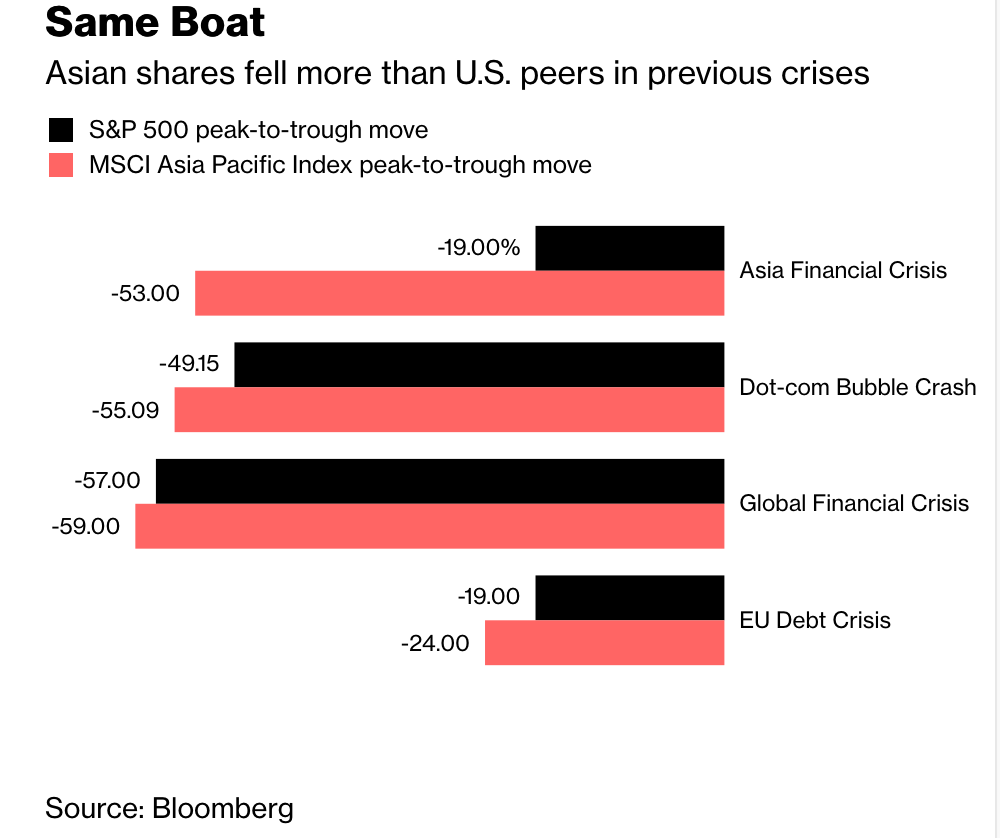
Today’s highly-interlinked, highly-levered financial markets of corporate securities-debt and equity as well as commodities generally, and all the myriad of long funds, portfolios and ETFs derived from these constituents–tend to move up and down together-worldwide.

The bottom line is simple:  risk assets come in different colors, but they are all jellybeans.  If jellybeans are falling and priced to be bad for your health, consuming one color over another is not going to help!

Only non-jellybean, low-fee assets, like cash, North American treasuries and some safe-haven currencies have typically offered capital shelter and some nourishment in these conditions.   Word to the wise.
Posted in Main Page | Comments Off on The truth about jellybeans

The Bank of Canada blinks–what’s your plan?

As we suspected it would, the Bank of Canada paused this morning in its rate-hiking aspirations, leaving the overnight rate at 1.75%, while noting in their press release slowing global demand, sharply lower oil prices, negative business investment, along with slowing household credit and weaker regional property markets.  At the same time, consensus expectations for a hike at the next January 9th meeting have fallen to less than 50% this morning.

In response, the Canadian dollar slumped a further .93% against the US dollar–down 6.3% year to date–and Canadian government bonds are rallying.  With the Canadian 10-year yield backing down to 2.12%, there’s a scant .07% spread today between it and the 2-year treasury yield–a fresh cycle low, reflecting the slowing outlook for Canada.

With US markets closed for the day, the Canadian stock market is mildly positive, but negative year-to-date, and the global market mood is decidedly ‘risk off’.

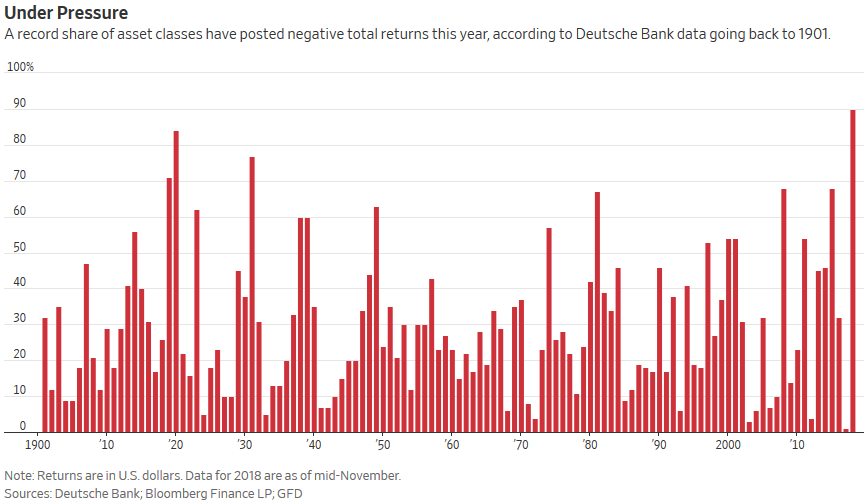
As shown below since 1901, a record 90% of asset types have posted negative total returns in 2018 (including income), and this long overdue ‘correction’ phase is only just started.   Speculation-gauge-cryptocurrencies continue melting, with pack-leader Bitcoin breaking to a fresh 2018-low below 3700 this afternoon.

Those with a proven value investment discipline have been tortoises in a race with QE-juiced-hares the past five years.  But each full-cycle race is measured from trough to trough, not trough to peak.  Only in the next market bottom, will we finally see who has what capital to show for the last decade of effort.  The most historically relevant markers confirm that seemingly endless ‘easy money’ made hares extra reckless this time around.

As usual, perma-bulls hope that monetary magicians will save irresponsible risk-takers from just desserts.  However, what I wrote in Bank of Canada ready to hike or blink? last September remains relevant to Canada, and most of the world today:

“With the madness of King Trump to our south, and a host of counter-productive policies undermining strength and stability in the free world at the moment, wage growth for the masses is going to continue to be elusive in Canada. The BOC can talk big on monetary policy, but at this point, they are carrying a minuscule stick. Canada has earned itself an extended rough patch and most Canadians don’t see it coming.”

While most will suffer from poor and non-existent preparation, pain is not impossible to avoid.  Those with a financial plan to protect and even grow capital through the rough laps will find that patience and personal discipline are back in the lead once more.

Posted in Main Page | Comments Off on The Bank of Canada blinks–what’s your plan?

Yield curves offer reality check to growth bulls

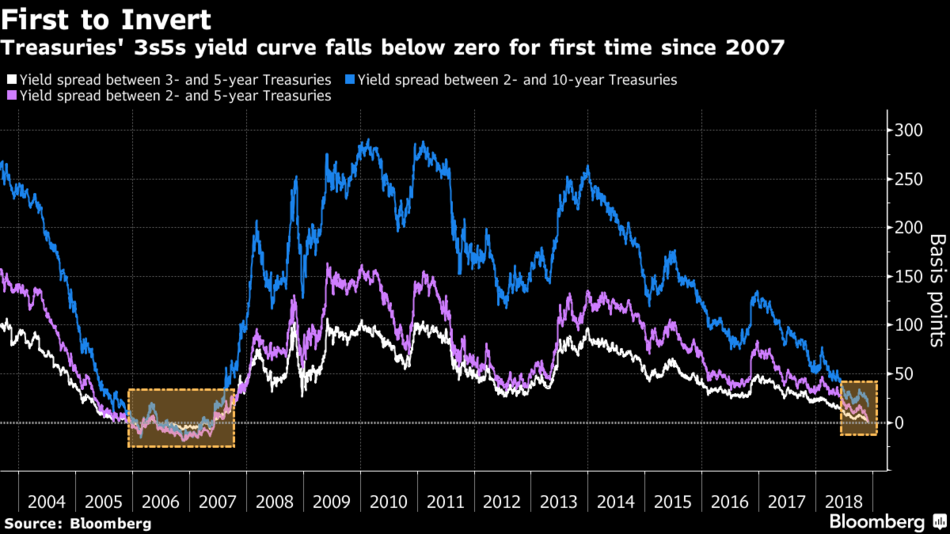
US 5 and 2-year and 5 and 3-year Treasury yield spreads moved negative yesterday for the first time since 2007, with the 10 and 2-year spread a minuscule .13 this morning. See Treasuries extend gains, after section of the yield-curve inverts.

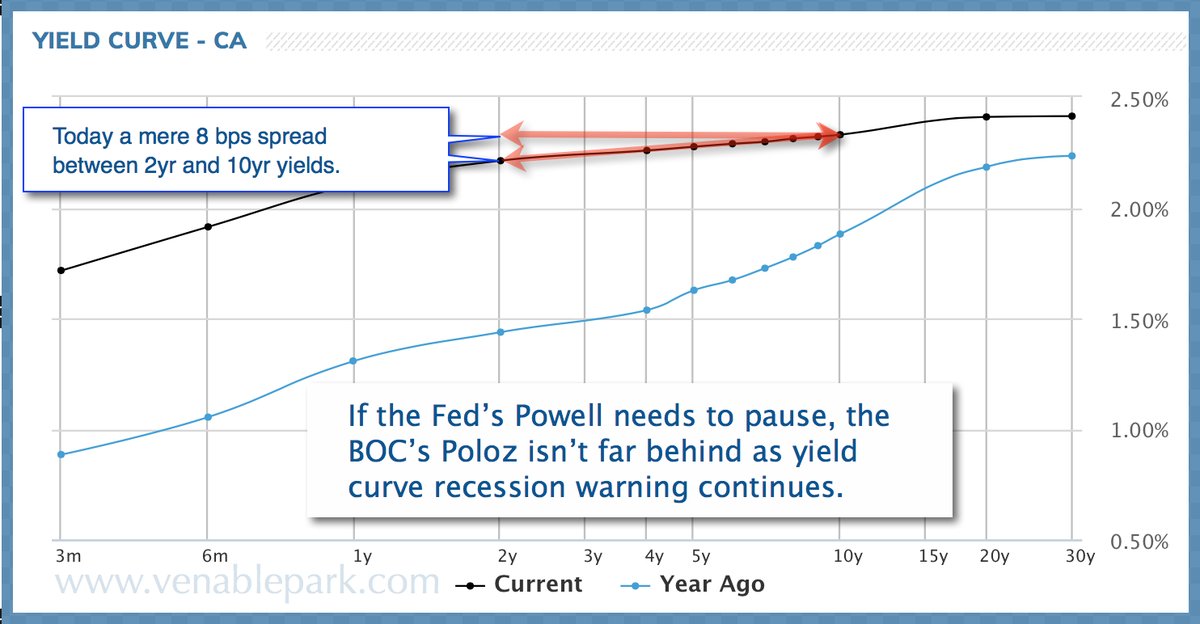
In Canada, the 10 and 2-year spread is also at a cycle low of .08 as shown here in my partner Cory Venable’s chart.


As we have been saying all year, central banks will not get as many hikes in as they hoped this cycle before the next recession overwhelms optimistic forecasts and prompts them into loosening mode once more. However, a rate pause and even further cuts typically work at a multi-month lag, which is unlikely to support equities and corporate debt anywhere near this cycle’s highs.

Indeed, as we have also noted repeatedly, the particularly precarious condition of the Canadian economy this cycle is giving the Bank of Canada (BOC) less fire room than the US Fed this cycle, making the BOC likely to pause within the next two months. Spreading recognition of this reality is putting a bid under Canadian government bonds once more, while equities and corporate debt deservedly continue to struggle. See: Traders bet Bank of Canada rate-hike pause may come sooner than the Feds.

Posted in Main Page | Comments Off on Yield curves offer reality check to growth bulls