In 1965 then US President Lyndon Johnson’s Science Advisory Committee published a report titled “Restoring the Quality of Our Environment,” that warned carbon dioxide was being added to the earth’s atmosphere by the burning of coal, oil, and natural gas at such a rate that by the year 2000 the heat balance would be so modified as possibly to cause marked changes in climate beyond local or even national efforts.
It goes on to warn of compounding harm in the form of melting ice caps, rising sea levels, acidification of water sources, and more:
“By the year 2000 the increase in atmospheric CO2 will be close to 25%. This may be sufficient to produce measurable and perhaps marked changes in climate, and will almost certainly cause significant changes in the temperature and other properties of the stratosphere.
…the pollution from internal combustion engines is so serious, and is growing so fast, that an alternative non-polluting means of powering automobiles, buses, and trucks is likely to become a national necessity.”
Rather than actively evolving consumption away from fossil fuels, governments doubled down on subsidies to producers and development of these self-destructive resources, while the sector spent fortunes to bury evidence and confuse the public into decades of apathy and denial.
Fifty-three years later, a new study published in the journal of Nature Communications this month, compares the stated ambition of countries to cut emissions with reality to date and concludes that China, Russia and Canada are the worst offending countries, followed closely by the US and Australia. See Policies of China, Russia and Canada threaten 5C climate change, study finds:
China, Russia and Canada’s current climate policies would drive the world above a catastrophic 5C of warming by the end of the century, according to a study that ranks the climate goals of different countries.
The US and Australia are only slightly behind with both pushing the global temperature rise dangerously over 4C above pre-industrial levels says the paper, while even the EU, which is usually seen as a climate leader, is on course to more than double the 1.5C that scientists say is a moderately safe level of heating.
In response, this week a Montreal law firm filed a class action against the government of Canada, alleging serious violations of constitutional rights arising from its failure to take necessary action to respond to the climate crisis. The complaint begins as follows:
“What is the purpose of a government if not to protect the lives and safety of its citizens? The facts outlined in this proceeding reflect an intentional assault on the part of the Canadian government for more than 25 years regarding climate change and the impact of this fault on the lives of young Quebecers. The government of Canada has behaved irresponsibly, and has failed to take action to prevent a serious threat posed to its people by climate change. These failures constitute an infringement of its citizens fundamental rights, especially the right to life and security of the youngest generations. While recognising the urgency to act and the serious dangers posed by climate change, the Canadian government has done virtually nothing.”
Catherine Gauthier of ENvironnement JEUnesse discusses the new action in this video clip.
As I have said many times, in a world where governments are captured by status quo corporations and industries, the last line of defense is legal process.
There is no doubt that governments have failed in their fiduciary duty to protect the best interests of their constituents, and class action lawsuits against them and offending corporations are deservedly spreading around the world.
The trouble is that damage awards against governments mean that we, the people and taxpayers, will be paying the bill. Not just to cover the damages awarded to different groups, but also to cover the ongoing costs to our health, sick care system and environment, on top of the massive infrastructure investment needed to transition to a sustainable future. We have no other choice.
But, suits and cross-suits will also follow the money in going after the corporations and executives who have extracted profits by causing the harm and leaving pollution and clean-up for the public.

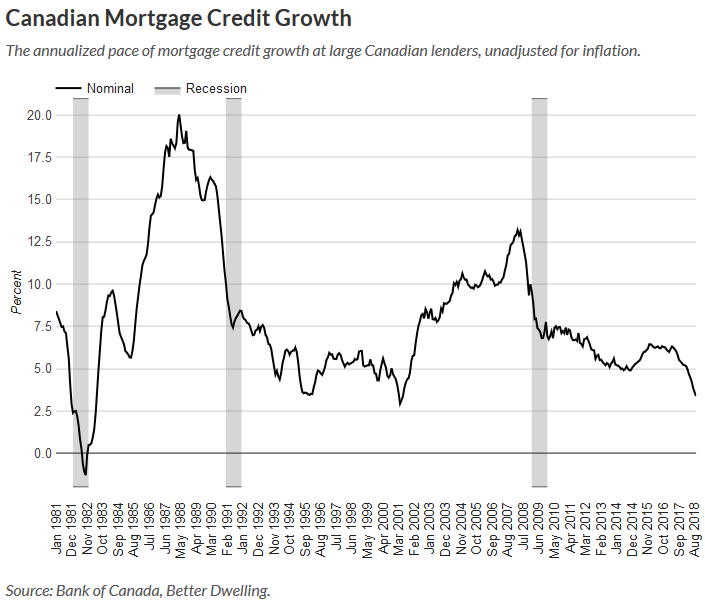
 While Australia and Canada boasted a record surge in home prices over the decade since the Great Recession, this also came with the commensurate surge in mortgage credit, and as shown below for Australia, both credit and prices are now following their natural path lower over the past year.