Successful lives use heads, hearts and hands

As I have mentioned before, I come from a long line of farmers and tradespeople, and was the first in my family to go to university.  And yes, my parents and teachers encouraged me to do so, and I appreciated their confidence in me.  Could I have built a successful business and happy life in a college or apprenticed trade instead?  With some good luck, I think so, since the traits and habits that make one successful, or not, tend to translate to whatever work we undertake.  I know that good manual skills are hugely valuable in life.  My husband and I have continually engaged in physical labor outside the office to great benefit all our lives.

Most fortunately, my family expected me to be not just studious, but also handy and adept at manual labor.  Many people who are trained for a desk job, are not expected to do be handy, just as many who are trained in the trades are not expected to be intellectual.  These things are not mutually exclusive of course, and we should not counsel young people to act as if they are.

I would note however, that ideas in this area seem to move in waves.  When my children were in high school they reported several career days, where teachers counselled the class to go into trades only and not university.   Our kids thought the anti-university bias also unhelpful.  We need knowledge and intuition to build skillsets for life–heads, hearts and hands.

Thanks to a reader for sending me the below clip–there many excellent points herein.

Mike Rowe, TV host of the popular show “Dirty Jobs”, testifies before the House Education & the Workforce Committee on the importance of career and technical education.  Here is a direct video link.
Posted in Main Page | Comments Off on Successful lives use heads, hearts and hands

Paying the Price: College Costs, Financial Aid, and the Betrayal of the American Dream

Nations that help wolves to eat their young don’t prosper.  Allowing financial sales firms to drive consumer protection policy is our collective undoing.

As the school year begins this week across the United States, the top student loan watchdog has resigned in protest, accusing the Trump administration of siding with powerful predatory lenders over student loan borrowers. Seth Frotman worked as student loan ombudsman under the Consumer Financial Protection Bureau director, Mick Mulvaney. He wrote that under Mulvaney’s leadership, “the Bureau has abandoned the very consumers it is tasked by Congress with protecting.”     Here is a direct video link.

Posted in Main Page | Comments Off on Paying the Price: College Costs, Financial Aid, and the Betrayal of the American Dream

When diversification doesn’t spread your risk

The financial business lives to churn out products for mass consumption, and they are excellent at selling them to us.  The trouble for buyers is that they tend to be different-wrapped packages of the same highly correlated securities, and so the appearance of diversity is one of form over content.

While rising capital inflows tend to inflate corporate securities all together, when risk-appetite turns they also drop en masse.  This truth was revealed in 2008-09, and for short-lived episodes since in 2011, 2015, 2017 and 2018.  It will be revealed in the next bear market as well–to the shock and horror of today’s hope-filled holders.

The Wall Street Journal highlights the issue today in When diversification doesn’t spread your risk, reviewing how colateralized loan obligations that blew up the economy in 2008 have become widely packaged and sold to risk-blind buyers again this cycle, to wit:

There is a simple lesson here for CLO investors: Never assume that investing with multiple managers diversifies your risk, as there is a fair chance you are buying many of the same underlying loans.

But there is a potential pitfall here that everyone should note. Today’s loan market has a much greater concentration of deals with low ratings, single-B and below, which are more prone to downgrades and defaults. More low-quality loans everywhere likely means more widespread losses when a downturn comes—no matter what kind of diversification you think you have.

The ramifications are much broader than for just CLO buyers however, because the contagion among corporate debt, derrivatives and equity prices is baked in the leverage linkages and behaviors that drive them each cycle.

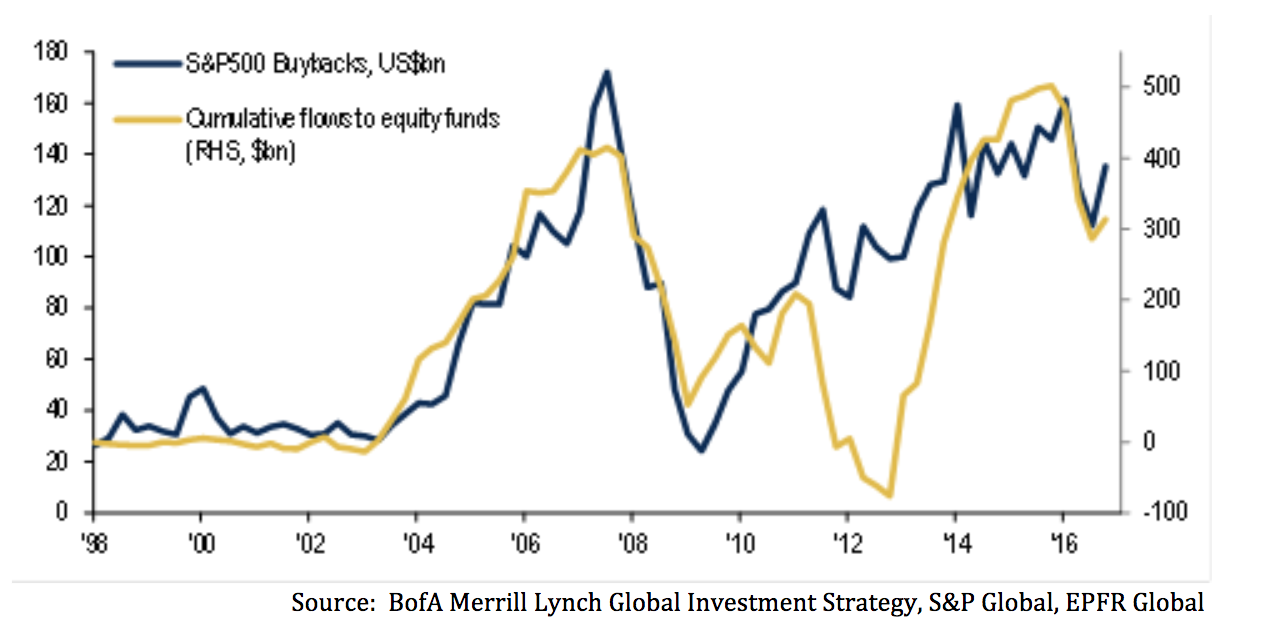
In equities, fund flows confirm that large corporations buying back their own shares–to boost prices and increase reported earnings per share–has been, by far, the largest net buyer of shares since at least 2009, as shown in the chart below.

Turns out this is especially the case, in low volume months like August, where executives use the pump of buyback announcements to liquidate their own personal holdings into policy-contrived strength.

All of this should be banned of course, and it may be again soon, as agregious insider-selling abuses have been recently noted in analysis by Robert J. Jackson, Jr. at the US Securities and Exchange Commission, and targeted by proposed new bills from Elizabeth Warren (D) and others.

Equity managers and products have lots of enticing different names, but they pretty much all track the same indices and each other.  So in reality, there is zero benefit in picking a bunch of different ones thinking you are adding diversity.  As the WSJ article admits:  “You are just buying the same stocks via different channels”.

The only meaningful capital-defense one can actually have is to adopt financial management rules and an investment discipline that moves inverse to the indiscriminate buying and selling of crowds.  The rest is all sales puff.

Posted in Main Page | Comments Off on When diversification doesn’t spread your risk