
New Study: carbon bubble burst coming, ready or not

As OPEC ministers agreed to increase oil production again last week, a new study published in the journal Nature Climate Change this month, shows that plunging renewable energy prices and rapidly increasing investment in low-carbon technologies could leave fossil fuel companies with trillions in stranded assets amid slumping market prices:

Several major economies rely heavily on fossil fuel production and exports, yet current low carbon technology, energy efficiency and climate policy may be substantially reducing global demand for fossil fuels.

This trend is inconsistent with observed investment in new fossil fuel ventures which could become stranded as a result…
Our analysis suggests that…would occur as a result of an already ongoing technological trajectory irrespective of whether or not new climate policies are adopted and there are clear distributional impacts, with winners (example, net importers such as China or the EU) and losers (for example, Russia, the United States or Canada, which could see their fossil fuel industries nearly shut down), although the two effects would largely offset each other at the level of aggregate global GDP.

Also see ‘Carbon bubble’ could spark global financial crisis, study warns:

“Contrary to investor expectations, the stranding of fossil fuel assets may happen even without new climate policies. Individual nations cannot avoid the situation by ignoring the Paris agreement or burying their heads in coal and tar sands.”

Mr Trudeau, please read this before you bail out anymore oil cos by buying antiquated pipelines off of them with scarce tax dollars.
Posted in Main Page | Comments Off on New Study: carbon bubble burst coming, ready or not

Capital hell unfolding for yield-reaching investors (again)

As the safest deposit and bond yields fell since the 2008 recession, people who could not afford/did not want capital losses migrated–willfully blind/desperate/greedily–into yield-reaching harm’s way.  One popular area has been ‘syndicated mortgages’ where borrowers find private lenders to loan money on properties instead of going to a bank.  Trouble is that most often these loans are subordinate to banks and other claimants already on the land and buildings.  No free lunch.  More pain and suffering coming in the Canadian mortgage market. See:  Fortress investors could face ‘significant losses.’

More than 11,000 investors – most in Ontario – invested $560-million to provide syndicated mortgage loans to Building and Development Mortgages Canada Inc., which raised the money to help finance 44 development projects for Fortress and its partners.

BDMC is owned by Ildina Galati, a former mortgage broker who surrendered her broker license in February as part of a settlement deal with Ontario’s financial regulator. BDMC was the principal mortgage broker for Fortress, and operates from the same office address. Vince Petrozza, co-founder and chief operating officer of Fortress, was also a registered mortgage broker with BDMC until his registration was revoked in February.

In its update, FAAN said it has spent much of its time as receiver dealing with applications from senior lenders who have priority claims on many of the development projects and are seeking to foreclose or seize the properties because of non-payment of their loans.

FAAN said it needs more time and money to do more appraisals of the projects to find the best potential outcomes for the syndicated lenders, whose loans often rank in third place or lower to those of other lenders.

Posted in Main Page | Comments Off on Capital hell unfolding for yield-reaching investors (again)

Policy interventions don’t eliminate bear markets nor conjure productivity

China’s Shanghai stock index closed last week down 4% and nearly 19% since January 26 even as the government continues with a barrage of ongoing confidence suasion efforts,  see Beijing paddles as bear market threatens:

The so-called “national team,” an assortment of government-backed investment funds that often acts to stabilize the market, still owns nearly half a trillion dollars worth of stocks, or around 6% of the total, according to Wind Information. Regulators have also been meddling in more subtle ways, like ordering brokerage firms or investors not to engage in heavy selling.

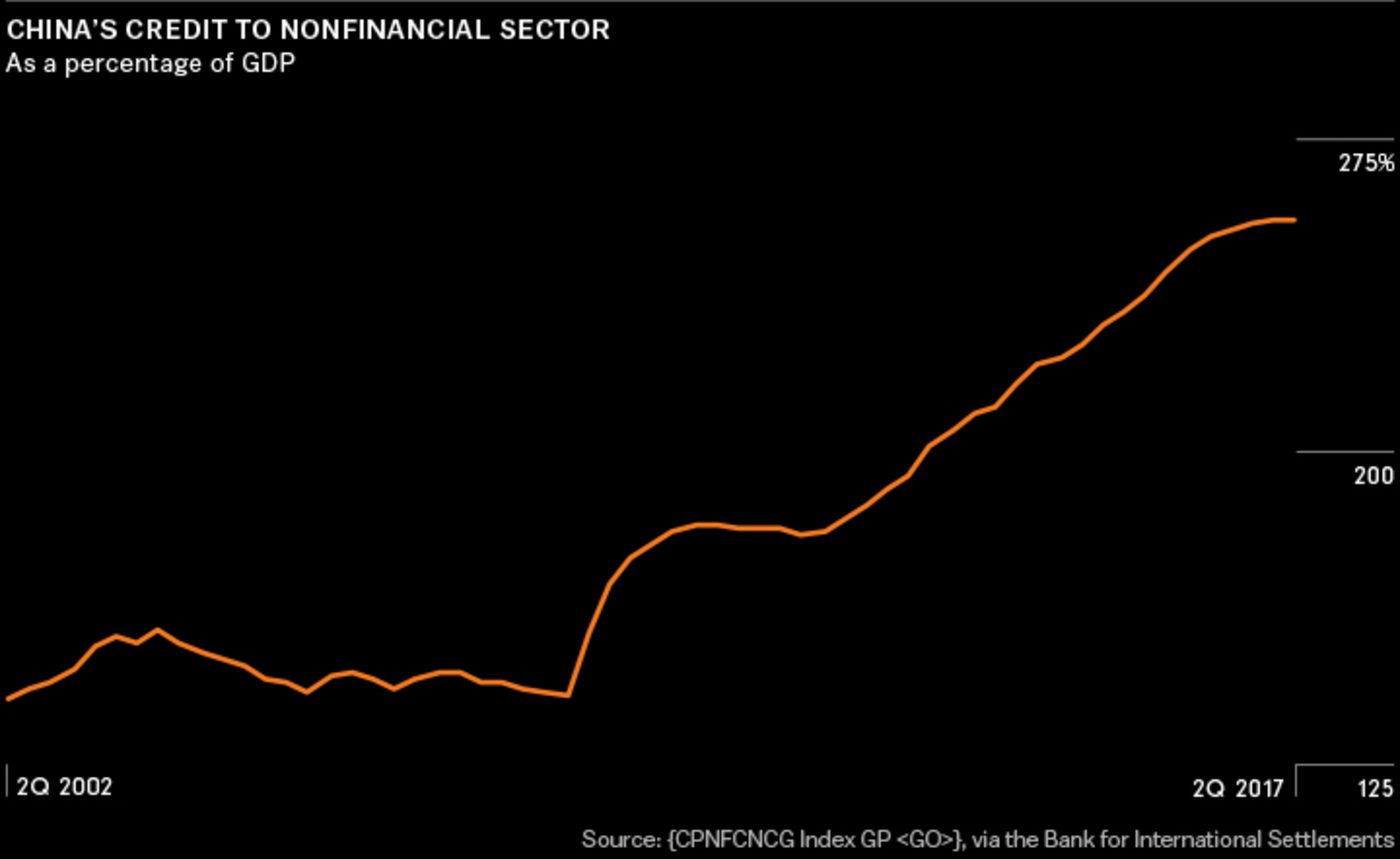
Eleven straight years of credit pumping and market rigging have led to massive debt and asset bubbles now hanging over China and the global economy. As shown here, China’s non-financial debt as a percentage of its GDP, at some 260%, has doubled since 2008.  See Sizing up China’s debt bubble.

Meanwhile, as shown in my partner Cory Venable’s chart below of the Shanghai stock index over the last 20 years, at 2889 today, the Shanghai index is back at the level it was in December 2014 …and February 2007 before that.

This is the natural course of mean reversion, financial engineering leads to temporary price inflation and then collapse with years and decades thereafter, trying to grow back to even.  More downside is likely from here with a retest of the 2009 and 2013 lows (red circles) probable as the global economy recesses once more.

The fundamental challenges of crushing debt and soaring defaults amid an aging population, slowing global demand and environmental unsustainability remain yet to be addressed.

‘Easy’ money policies start quick and easy but end up long and hard.  Monetary magicians can keep trying tricks but they can’t avoid the cleansing necessity of bear markets nor conjure higher productivity.  The latter takes hard work:  reform, innovation, higher efficiency, less debt, more savings and time.


Posted in Main Page | Comments Off on Policy interventions don’t eliminate bear markets nor conjure productivity





