Danielle’s bi-weekly market update

Danielle was a guest with Jim Goddard on Talk Digital Network, talking about recent developments in the world economy and markets, you can listen to an audio clip of the segment here.

Posted in Main Page | Comments Off on Danielle’s bi-weekly market update

Financial stress spreading in Canada’s most populous areas

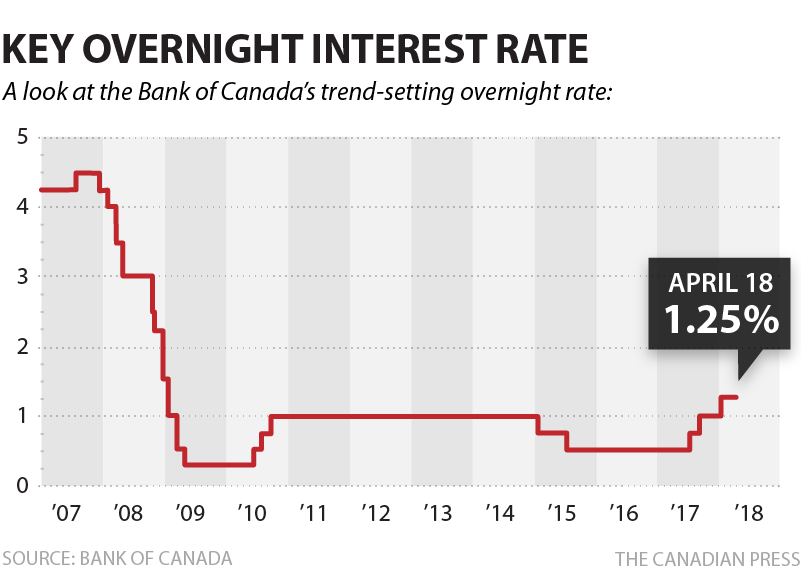
While affirming a tightening bias, The Bank of Canada blinked again today, opting to not raise its overnight rate for the second time in two months, noting the Canadian economy was slightly weaker than the bank had expected in the first quarter of 2018.

Its next meeting date is May 30.

Meanwhile despite still relatively low interest rates by historical standards, stress is already spreading in the highly indebted household sector.

The fall census revealed that just under half a million Canadian households with mortgages spend over 50% of their household incomes on shelter costs – mortgages, taxes and utilities.  See Canadians under water. Where, exactly, rising rates may leave Canadians under water:

“The old guideline was about 30 per cent. Even if you make that 35 or 40, you’re seeing people with 10 or 20 per cent more than that,” Toronto-based insolvency administrator Scott Terrio says of his clients.

Stressed households are concentrated in cities where real estate is most expensive – Toronto and Vancouver, but also noticeably in Barrie, Hamilton and Victoria.  Most other Canadian communities are below 8 per cent.”

Trouble is that a quarter of Canada’s population lives in these most debt-stressed Greater Vancouver and Toronto Areas.

As real estate and related spending rose far above norm in the most populous areas over the past few years, it lent a concentrated boost to Canadian economic growth broadly.  Likewise, price declines, reduced spending, defaults and stress in these same areas now, should have a similarly concentrated effect on the Canadian economy to the downside.

Posted in Main Page | Comments Off on Financial stress spreading in Canada’s most populous areas

Seasonality and greenback/loonie cycles

The loonie has rebounded 2.7% against the greenback so far in April, leading some to predict that another up-cycle for commodities, Canadian equities and the C$ has begun. But, the loonie has climbed with oil prices in 8 of the last 10 Aprils, only to retrace again in the month thereafter.

The larger perspective, as shown in the below chart since 1994, from my partner Cory Venable, is that late in economic cycles when growth and revenues disappoint, the US dollar typically rallies, while oil and commodity-centric currencies weaken.

Not only is the global benchmark currency a relatively deep and liquid ‘safe haven’ in times of global financial strain, but the bulk of global debt (some $237 trillion today) is owed in US dollars.  As US spending and imports fall, so does the inflow of US dollars to foreign exporters who need greenbacks to make their payments.  This naturally prods them to buy more US dollars, and traders pile on for the ride.  These factors compound rising U$ costs and shrinking free cash flow for foreign borrowers and exporters.

As noted below, the U$ does not typically top out against the C$ until the equity market ‘risk-off’ cycle has bottomed.
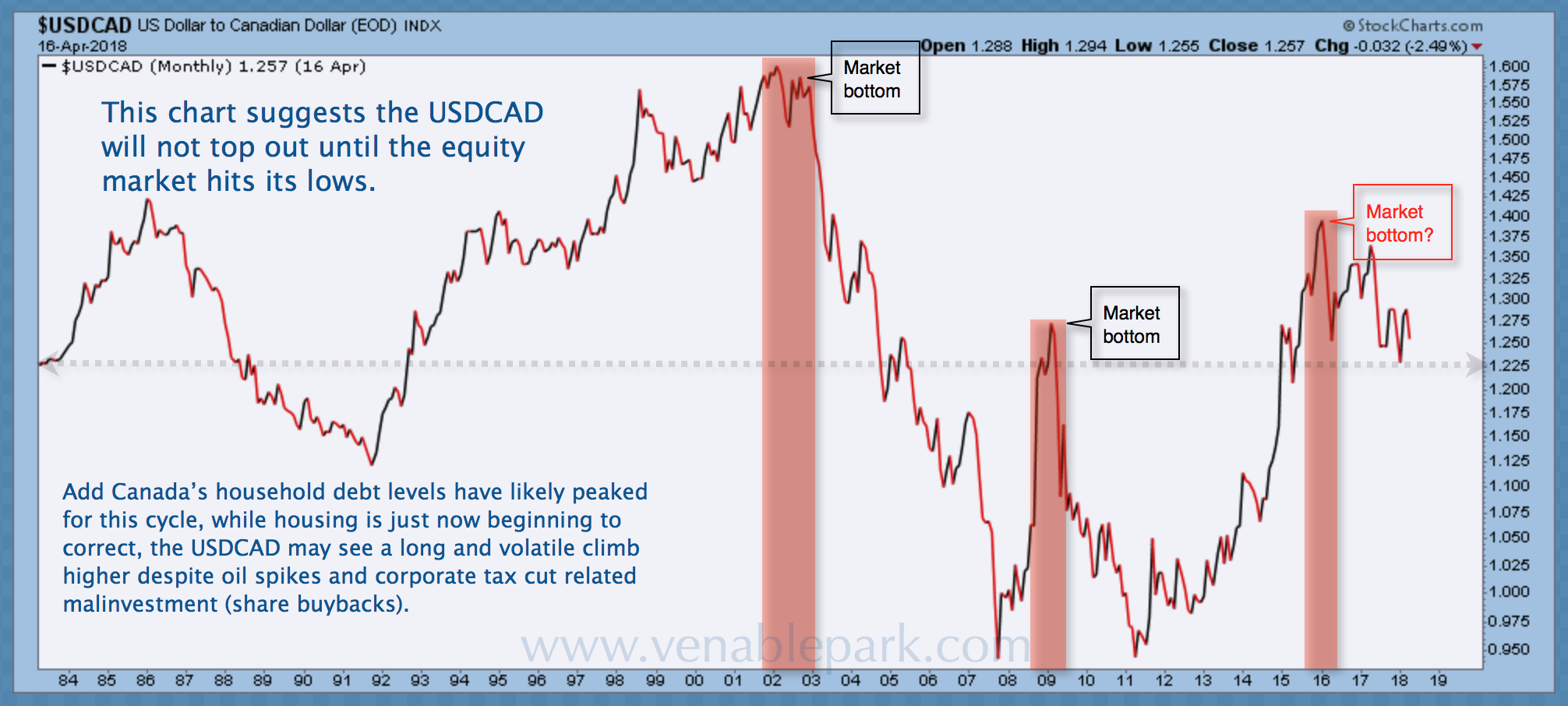
Despite 2018 seeing a negative first quarter for stock markets, declines have been modest thus far.  And unlike the last two, this contraction cycle has the added distinction for Canada of boasting some of the most over-valued realty and indebted households in the world, going in.

We suspect that the loonie is unlikely to have fathomed a durable cycle bottom just yet.

Posted in Main Page | Comments Off on Seasonality and greenback/loonie cycles