‘Hyper-leveraging’ means Canada hyper-sensitive to mean reversion

Using high leverage–borrowing to ‘invest’ or spend–is like driving 200 miles an hour everywhere that you go. So long as weather is perfect, there are no turns, no judgement or mechanical problems, and nothing ever comes into your path, you will undoubtedly get to your destination faster.  But as soon as anything does occur, you have a huge probability of wiping out yourself and your surroundings.  After 9 years of record leveraging, a recent report from MacQuarie Capital Markets reminds of a timeless truth now haunting many countries, and Canada in particular. See: Hyper-leveraging risks Bank of Canada policy error:”

The unprecedented rise in consumer debt means the Bank of Canada’s rate-hiking cycle is already the most severe in 20 years and further increases will have far graver consequences than conventional analysis shows, Macquarie Capital Markets Canada Ltd. said.

Assuming just one further rate rise, the impact would be 65 percent to 80 percent as severe as the 1987 to 1990 cycle, according to Macquarie, which took into account five-year bond yields, household debt and home buying. Canada’s housing market slumped in the early 1990s after that rate-hike cycle and a recession.

Although a distinction I would make here: the policy error that has been replicated by central banks around the world, is not increasing rates off the zero bound over the past year, but rather, the error was in leaving rates near zero for the unprecedented 8 years before that.  It was this madness that encouraged and enabled the self-destructive financial decisions now ailing us.

It is necessary to try and raise policy rates as well as lending standards from what has been years of recklessly low levels–although there is little room to continue much further this cycle, before the slowing economy prompts cries for cuts and easing (!) again.  In the meantime though, asset prices that have been ramped up unreasonably on rising leverage, will come back down to reconnect carrying costs with free cash flow.  Falling asset prices will also compound problems for those needing to refinance or sell into strength.

For real life examples of household financial stress already in motion, watch ‘Digging out of debt, real life scenarios’ with Canadian trustee in bankruptcy Scott Terrio.
Posted in Main Page | Comments Off on ‘Hyper-leveraging’ means Canada hyper-sensitive to mean reversion

Danielle on The Financial Survival Network

Danielle was a guest on The Financial Survival Network with Kerry Lutz, talking about recent developments in the world economy and markets, you can listen to an audio clip of the segment here.

Posted in Main Page | Comments Off on Danielle on The Financial Survival Network

Bond bear due for hibernation in 2018?

Tax cuts and hope for accelerating economic growth, inflation and interest rates in 2018, have rendered an even wider than usual consensus that treasury prices can only go down from here.  January did see a further sell off in government bonds and gap higher in yields. And this did increase the cost of borrowing for consumers, business and governments alike, and there in lies a rub. With the world more indebted than ever before, and much worse than in 2008, rising rates crimp already tight cash flows.

It’s also the reason that bond prices typically fall first at the top of each credit cycle as monetary conditions tighten, and are then soon followed by deflating stock and commodity prices.  (See The valuation cycle strikes back) for more.

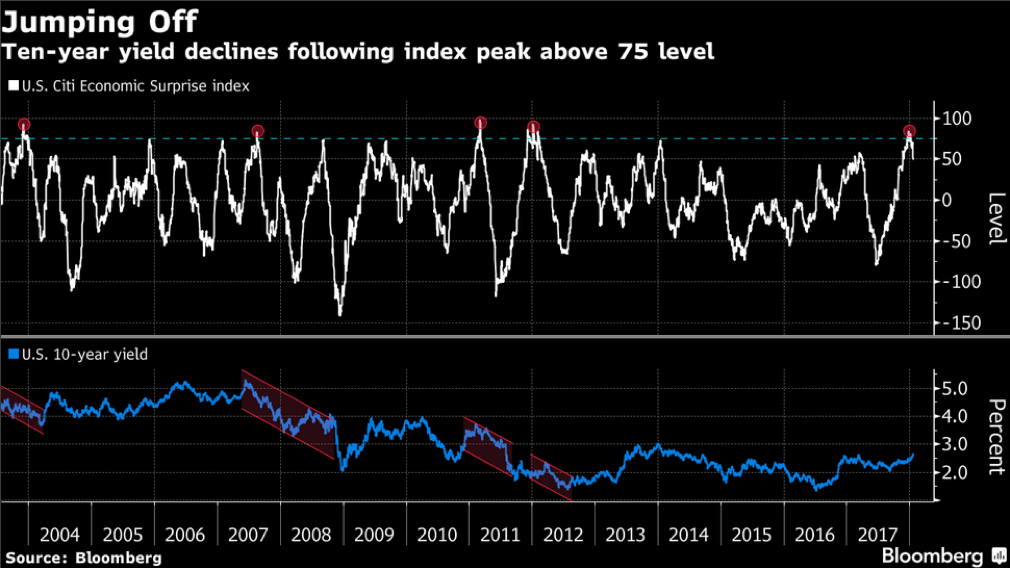
When credit cannot get any looser, employment, income and ‘upside surprise’ any better, then spending retreats, the economy weakens, everyone looks to central banks for more slack and ‘safe-haven’ treasuries are bid once more.  The below chart of the US economic surprise index (in white) and the US 10 year Treasury yield (in blue) since 2003, shows the pattern.  When the upside surprise index tops 75, good news has been over-priced and disappointment and falling treasury yields are due.  See: Markets are about to get ugly according to these charts.

December was only the fifth time since 2003 the economic-surprise index peaked above 75. From each peak to the corresponding trough, 10-year yields on average dropped 1.11 percentage points over the next seven months, according to data compiled by Canaccord. Bonds have yet to respond to recent disappointing data, as the 10-year approaches the 2.66 percent high watermark set in 2014.

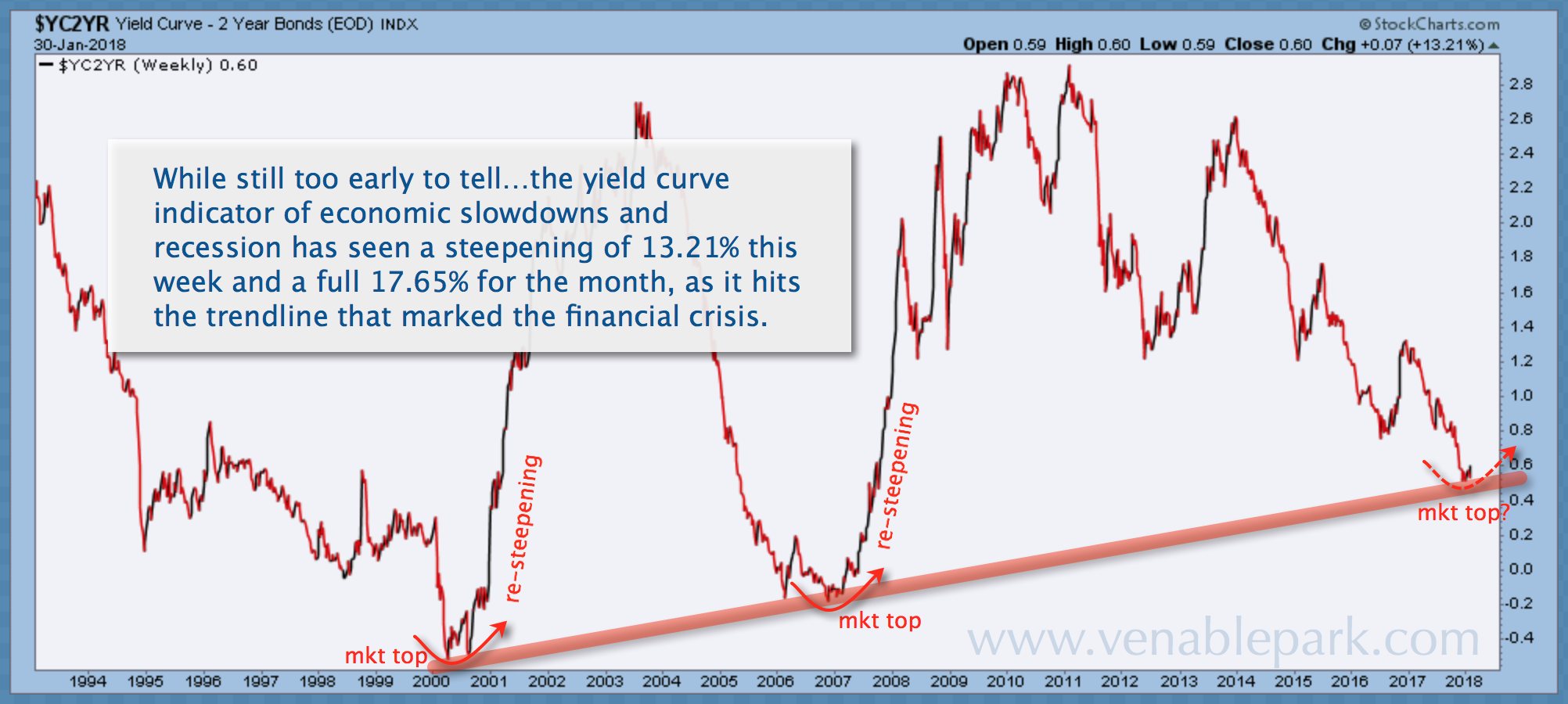
If disappointing economic activity now prompts central banks to hike rates less than they have planned (hoped), and 10-year treasury yields begin to fall (bond prices rise) over the next several months, then, as charted below by my partner Cory Venable, we may also be at the end of the equity market expansion cycle as in 2000 and 2007.  Then as now, of course, hardly anyone is prepared for that.

Posted in Main Page | Comments Off on Bond bear due for hibernation in 2018?