Plant-based diets improve health, planet and food supply

A new study published in the Proceedings of the National Academy of Sciences finds that if the U.S. population opted for a plant-based diet, instead of an animal-centric one, it would reduce greenhouse gas emissions from agriculture by about 28% and increase total food production for humans by about 23%.  Today 47% of soy and 60% of corn crops are grown to feed livestock, not to mention all the water waste and pollution these practices bring.

Now factor in the massive health benefits and cost-savings from a dramatic drop in diet related illness and disability–including heart disease, obesity, diabetes and cancer, and the rational course is obvious.  Starting just one person at a time, better ideas can spread. The motivation is overwhelming, see Study finds plant-based diet could reduce green-house emissions and increase food supply.

Industrialized animal agriculture is the largest singular driver of climate change, responsible for more greenhouse gas emissions than the entire transportation sector, and is also the culprit behind mass deforestation, water, and air pollution. Considering most people consume about double the amount of protein they need, two-thirds of which comes from animal sources, our everyday eating habits are taking a massive toll on the planet. What’s more, despite all of the resources used and pollution created, one in eight people still suffer from food scarcity.

 

Posted in Main Page | Comments Off on Plant-based diets improve health, planet and food supply

Investment marketing wrappers and the rot within

Exchange Traded Funds (ETFs), mutual funds or indices are only a marketing wrapper or package around a group of individual securities. Reassuring names aside, their investment prospects can only be as good as the individual constituents within– defined by their market price versus earnings, sales, assets, cash flow and future prospects–and the macro cycles at hand.

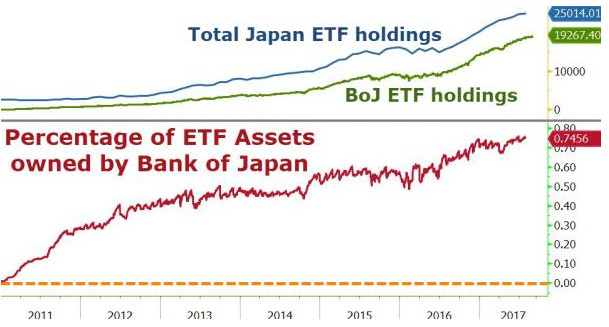
Worse this time, this market cycle has seen trillions in indiscriminate fund flows driven by central banks into ‘passive’ security packages all around the world. Just one example, the QE-world-leader the Bank of Japan, now personally owns some 75% of all the ETFs in the country, as shown in this graph courtesy of zerohedge.com.  This is not about investing.

Mindless global fund flows have become so garish and irrational this cycle that even people like Robert Shiller–who partnered with index producer Standard and Poor’s over the past decade- are having to admit the allocations make zero sense:

“The strength of this country was built on people who watched individual companies. They had opinions about them. All this talk of indexes, it’s a little bit diluting of our intellect. It becomes more of a game,” Shiller said Monday on CNBC’s “Trading Nation.” “It’s a chaotic system.” See: Robert Shiller on what worries him about passive investing.

The idea that buying and holding packages of hideously over-valued securities is sound investing has never been true. It has however, been the marketing machine of choice in the fee-gorging financial sector.

Perhaps buyers prefer not to contemplate the worry and risk of over-valued asset markets and prefer anesthetizing marketing wrappers that gloss over the unpleasantness of rot within. It will not protect them from it though.  Out of mind remains real and present danger.

Posted in Main Page | Comments Off on Investment marketing wrappers and the rot within

MacLean’s: How Canadian homes became debt traps

Tale as old as time:  over-spending, under-saving, taking on debt to elevate ‘lifestyle’, tax-payer backed programs designed to enable bad habits, and a finance sector recommending destructive behaviors including the ‘miracle’ of Home Equity Lines of Credit (HELCOs) and ‘borrowing to invest’.  See How Canadian homes became debt traps:

HELOCs have been around in Canada since the 1970s, but in the mid-1990s, lenders started marketing them to a wider swath of consumers. Between 2000 and 2010, HELOC balances soared from $35 billion to $186 billion, according to the Financial Consumer Agency of Canada, an average annual growth rate of 20 per cent.

The pace of growth has slowed since then, but balances still hit $211 billion last year…

It marks a fundamental shift in the way Canadians think about homeownership. “Whatever happened to getting to the end of a mortgage and owning your home?” says Gilbertson, the trustee in Vancouver. “It’s less about truly owning our homes today and more about having another revenue stream to fund our lifestyles.

Traditionally people reach a trigger moment when they can no longer pretend—a job loss, say, or divorce or illness. But increasingly bankruptcy counselors are noting a rise in clients filing simply because they have far surpassed the end of what their cash flow can service, even while they are still working, and before any major life shock.

“The insolvency business is cyclical, and we’re at least a year overdue for shedding blood in the system,” Scott Terrio, [an insolvency estate administrator] says. “If ever we were poised to hit that right on the head, it’s now.”

Posted in Main Page | Comments Off on MacLean’s: How Canadian homes became debt traps