
Debt-fueled-consumption-supercycle in retreat: “We’ve wasted our gravy train”

In 1880, Melbourne Australia was the richest city in the world, until it had a property crash in 1891, halving home prices and launching the nation into an economic depression that was longer and deeper than the Great Depression of the 1930’s.  According to Macro Business, it took 70 years for the housing market to recover its 1890’s price peak.

In the most recent credit-fuelled-consumption supercycle, Australia repeated many of the same mistakes. Canada (and other commodity-centric countries) too.

As shown in the chart below, Australia’s big four banks who issue 80+% of residential mortgages in the country, are more exposed as a percentage of their loan book than any other banks in the world–making up over 60%–double that of the US, triple that of the UK and quadruple that of Hong Kong (the least affordable place in the world for real estate).  Canada’s big 5 bank concentration in residential mortgages is fourth largest in the world at 38%.  Not surprisingly, the big bank CEO’s and analysts in both Canada and Australia assure all who listen that housing prices today are “justified by fundamentals”
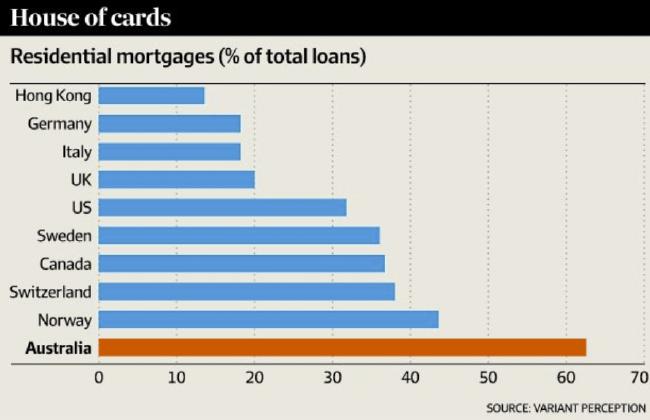
Different countries, but many of the same themes and behaviors have driven the debt disease now plaguing households.  Must read  Australia’s House of Cards (long version with great charts), or a condensed version was published here. A few highlights:

“Already at the time of the GFC [great 2008 financial crisis], Australian households were at 190 per cent debt to net disposable income, 50 per cent more indebted than American households, but then things really went crazy.

The government decided to further fuel the fire by “streamlining” the administrative requirements for the Foreign Investment Review Board so that temporary residents could purchase real estate in Australia without having to report or gain approval…

I am not sure who is getting the last laugh here, because as we subsequently found out, many of those Chinese borrowed the money to buy these houses from Australian banks, using fake statements of foreign income. Indeed, according to the AFR, this was not sophisticated documentation — Australian banks were being tricked with photoshopped bank statements that can be bought online for as little as $20.

UBS estimates that $500 billion worth of “not completely factually accurate” mortgages now sit on major bank balance sheets. How much of that will go sour is anyone’s guess.

Foreign buying driving up housing prices has been a major factor in Australian housing affordability, or rather unaffordability.

At the end of July 2017, according to Domain Group the median house price to household income ratio for Sydney was 13x, more than 2.6x the threshold 5.1% considered by urban planners as ‘severely unaffordable’.

This is before tax, and before any basic expenses. The average person takes home $61,034.60 per annum, and so to buy the average house they would have to save for 19.3 years — but only if they decided to forgo the basics such as, eating. This is neglecting any interest costs if one were to borrow the money, which at current rates would approximately double the total purchase cost and blow out the time to repay to around 40 years.


Posted in Main Page | Comments Off on Debt-fueled-consumption-supercycle in retreat: “We’ve wasted our gravy train”

End running trust-abusing financial intermediaries

We have been quietly reading and watching the evolution of blockchain since the introduction of its first application Bitcoin, in 2008.  It is a complex, new world paradigm, where one is well advised to study, process and think before making conclusions or taking any action.

Among a growing body of legitimate developers and end users in this platform, there are also a swarm of the usual speculators and fraudsters working to drive Bitcoin and subsequent cryptocurrencies through price moves that have little connection with the value and purpose of blockchain technology itself.

Still, in a time where a centralized financial system has developed to grossly enrich those in control positions by taking advantage of trusting customers and undermining the economy, blockchain is an evolution that’s time has come.

As Caitlin Long explains well in the discussion below, blockchain challenges the fraud and opaque, abuse-of-trust-business-model currently dominating the global financial system, and “the mechanisms in capital markets that skim value unfairly from mom and pop.”  It’s ironic, but no wonder then, that JP Morgan’s Jamie Dimon and other big finance executives are threatened and decrying this technology as a fraud.  When we, the people, can take back control and accountability in our financial transactions, the tyranny of big banks will be over.

Bitcoin, the world’s first and largest cryptocurrency, and the blockchain, which is its underlying technology, have the potential to change everything from record keeping to the global financial system. The blockchain is a decentralized database that allows individuals to trade directly without the need for a third-party intermediary. Bitcoin is free-market money that runs on the internet, and it isn’t controlled by a political entity or central bank. It’s easy to see bitcoin and the blockchain as logical extensions of the internet, with the potential to shift power from governments to individuals. It’s also not clear how a fully decentralized money and public-ledger system are going to be implemented and brought to bear on everyday life. Reason’s Nick Gillespie sat down with Caitlin Long, one of Inc. magazine’s “10 business leaders changing the world through tech,” a former managing director at Morgan Stanley, and the current president of Symbiont, which is bringing blockchain technology to Wall Street.

Caitlin Long of Symbiont sits down with Reason’s Nick Gillespie to discuss how blockchain technology can make the financial system more transparent.  Here is a direct video link.

Posted in Main Page | Comments Off on End running trust-abusing financial intermediaries

Be the change: returning to zero waste groceries

It’s the kind of list you don’t want to find your country on. But Canada is right near the top of the world, in the amount of garbage we produce per person.

You don’t have to look far to find a major culprit: ridiculous packaging.

Valerie Leloup knows packaging better than most. But her new store has absolutely none of it.  Here is a direct video link.

Posted in Main Page | Comments Off on Be the change: returning to zero waste groceries



