Familiar financial restraints Down Under

Australian’s are struggling with record household debt, flat incomes and a migration to gambling and lotto tickets. Sounds familiar.

Every year, the largest and most detailed ongoing study of Australians gives us a snapshot of where the country is at. This Household, Income and Labour Dynamics in Australia Survey is known as HILDA. You can read more on this year’s HILDA survey on Pursuit, the University of Melbourne’s multi-media news site.  Here is a direct video link.

Posted in Main Page | Comments Off on Familiar financial restraints Down Under

Epic era of financial deceit due for a comeuppance

In 1998-2000 I witnessed many promotional pitches from companies that used so many acronyms and buzz words that you were left none the wiser as to what they did even after a 15 minute presentation with glossy charts.  I remember thinking ‘perhaps I’m thick, but I’m not following your value proposition’.

Turned out skepticism was good self-defense.  When capital flows evaporated in 2000, shares of all companies fell, but the many with non-viable business models that had been just surfing waves of indiscriminate capital went bust, taking gullible buyers down for the ride.

In the latest speculative episode, buzz word genius has been all about ‘implementation methodologies’, ‘quantitative investing’, ‘risk-parity’ etc.   This clip says it all.

Ryan Tolkin, the CIO of a $16 billion hedge fund Schonfeld Strategic Advisors, helped us understand what quantitative trading actually is. Here is a direct video link.

If you’re shaking your head in confusion after listening, it means your dung filter is still working.  That’s a good sign.  The other little problem in all the confident talk about relying on computer models and taking human emotions out of investment decisions, is that the capital being ‘deployed’ belongs to humans who, in times of financial strife or falling prices, will ask for their cash back regardless of what the trading models suggest.

In the end, all this madness has only been possible by using the public purse to bail out and backstop financial intermediaries, allowing financial criminals to skirt prosecution, regulatory capture, high-powered computers and trillions of central bank prestidigitation that funneled ‘free’ money into casinos formerly known as ‘investment’ markets.

Still, as in every other prior episode, there is no doubt that this latest wave of financial fraud and abuse too shall end in a cremation of capital and players.  While the earliest riggers and skimmers had a remarkable run early on in this game, their success has had the usual full circle effect of attracting so many others and leverage into their game, that the legitimate investor flows on which they preyed for profits have been marginalized, leaving an ocean dominated by sharks trying to feed on each other.  See The fastest traders on Wall Street are in trouble:

HFT firms have been facing stiff headwinds due to low volatility,” Richard Repetto, an analyst at Sandler O’Neill + Partners told Business Insider in an email. “Both implied and intraday volatility have been at lows making it difficult for HFTs to earn meaningful spreads.”

Total revenues brought in by HFTs from equity trading have dropped over 85% from $7.2 billion in 2009 to $1.1 billion in 2016, according to data from the TABB Group. The consultancy expects revenues to slide to $900 million this year.

The payback period has begun.  Couldn’t happen to a more deserving bunch of folks.

Posted in Main Page | Comments Off on Epic era of financial deceit due for a comeuppance

Transport sector racing into creative destruction

Riding-share-company Lyft’s director of product, recently talked to MarketWatch about how autonomous vehicles will revolutionize the ride-sharing industry within the next 4 years. Here is a direct video link.

This evolution is so imminent now that even the notoriously dysfunctional US House of Representatives yesterday unanimously approved a bipartisan Self Drive Act that limits states from controlling how automakers construct and design self-driving cars. It also allows automakers to deploy 25,000 self-driving cars in the first year, rising to 100,000 over a three-year time span.  See:  Self-driving car bill passes the House

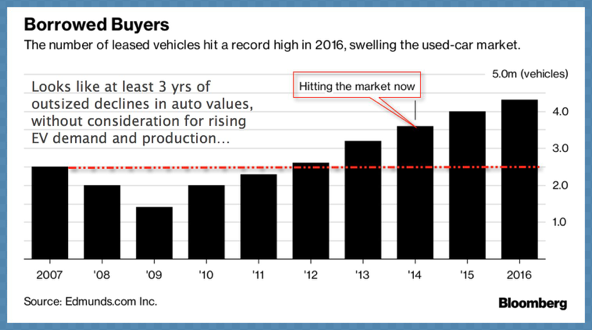
Representing 20% of US retail sales, the auto sector was a key GDP driver out of the 2008 recession, as government-backed ‘cash-for clunker’ programs and finance enabled ‘easy lease’ terms helped millions of people, with little-to-no-actual money, drive away in new vehicles.  At the cycle’s peak in February 2016, auto leases made up one third of new car sales and have averaged about 30% since.

The trouble is that the millions of vehicles coming ‘off lease’ are now gushing used cars on to the resale market where prices have been falling since 2014.  An additional 11 million+ are slated to come off-lease over the next 2.5 years.

Lower than expected ‘residual’ prices are eating profits for the finance companies that offered lease contracts on the assumption of higher end values.  This also means that new leases will be more expensive and less possible for the cash-poor masses going forward.

This suggests ongoing price declines for used and new cars.  Good for consumers who have money and interest in buying vehicles.  Not so good for the top-heavy, indebted, old-tech-dominated transport and auto sectors, about to be side-swiped by demand evaporation and dramatically less maintenance and repair revenues from an incoming fleet of shared, autonomous, electric vehicles.  No wonder even the out-of-touch US Fed expressed worry about the US auto industry in their Beige book notes released yesterday.

This evolution will lower consumer costs, increase efficiency and air quality, reduce noise and carbon emissions, while freeing up acres of land from parking lots and freeways for more productive uses.  All good.  But not without some business casualties and economic upheaval in the process.

Posted in Main Page | Comments Off on Transport sector racing into creative destruction