
Painted into a corner

The loonie is bid today on the Bank of Canada’s first rate hike in 7 years.  Not a surprise, this hike was forecast by 90% of market participants surveyed in advance.  Less anticipated by the consensus was US Fed Chair Yellen’s more dovish testimony today that the federal funds rate may “not have to rise all that much further to get to a neutral policy stance.” No kidding!

Nine years of recklessly low policy rates and toxic debt increases have continued to weaken financial strength and suppress the velocity of money (movement of money through the real economy), no matter how much central banks dream about ‘stimulating’ demand.  At these extremes, monetary levers are powerless and even counter-productive when it comes to economic growth.

Another traditional supply/price relationship also broken:  falling oil prices are not causing producers to pull back.  Indeed while West Texas Crude broke below $44 a barrel this week, US production and exports soared to their highest level ever, even as OPEC and the many other non-OPEC members gun for needed cash flow by pumping more as prices fall.  Canada too.

As currency traders chase after the diverging rate story in Canada (tighter) versus the US (on hold?), a bi-polar reaction is very likely to unfold. Initial trader excitement that “the BOC is raising rates!” is likely to soon become “oh no, the BOC is raising rates!” as excessively leveraged Canadian households, businesses and exporters grapple with the strain of rising debt service and falling sales/revenues/employment.
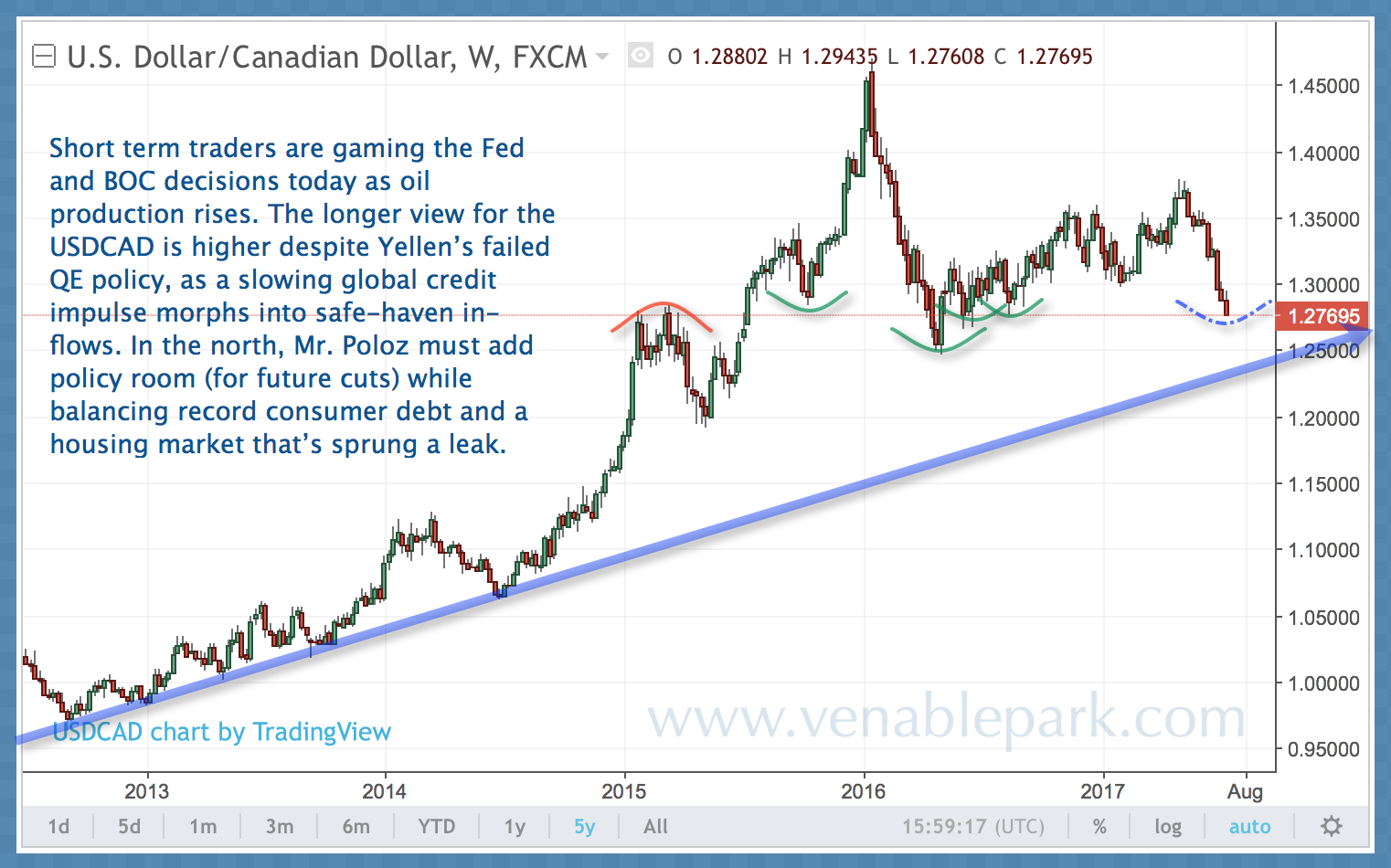

Rates must rise to restore viability to the financial system–and any hope of credibility for central banks–and yet higher rates will help prompt lower consumption, lower asset prices, an overdue economic recession, bankruptcies, write offs, larger government deficits and relative safe haven flows back to the US dollar.  The North American economy, like most others, has been painted into a corner.

Posted in Main Page | Comments Off on Painted into a corner

LA to NY in record time with zero noise or pollution

As the first 30 Tesla Model 3’s (from $35K USD) are delivered to their excited owners on July 28 the company is dramatically increasing its network of service centers and supercharging stations.

Jordan Hart and Bradly D’Souza set out in a Tesla Model S 85D on July 1st from LA to NY and set a new record by arriving in 51 Hours and 47 Minutes, besting the previous record held by Alex Roy and friends of 55 hours by a whopping 3 hours and 13 minutes. Here is a direct video link.

Posted in Main Page | Comments Off on LA to NY in record time with zero noise or pollution

Canadian borrowers losing ability

Home sales in Canada’s largest city–Toronto–fell 37% year over year in June. Long overdue buyer exhaustion has finally been triggered after the Feds tightened mortgage insurance requirements last November and Ontario imposed a 15% tax on foreign purchasers in April.  Now regulators are considering new rules requiring lenders to stress test uninsured mortgages (prompted by oversized loss risk in the sector).

In addition, on Wednesday, the Bank of Canada is expected to raise its benchmark overnight rate to .75% from .50%. In anticipation, Canada’s biggest banks are also tightening. Royal Bank of Canada raised its fixed rates for 2-,3-, and 5-year term mortgages by .20%. See:  Canadian home buyers losing steam, and cash.

With some 90%+ of Canada’s economic growth coming from realty transactions and services the past 2 years, we doubt the BOC and banks will raise rates far before declining property prices and a weakening economy cause them to pause once more.  But at this point, holding rates lower for longer is not going to repair or even meaningfully patch the financial leak.  This is Canada’s payback period due after a decade of reckless credit abuse.

Next up will be a necessary cleansing cycle resulting in lower shelter prices to help restore affordability once more and reset many over-leveraged participants–households and businesses–through bankruptcy, credit restructuring and write downs for lenders.  It will also mean lower tax revenues for governments that have become unduly dependent on what has been the one firing economic cylinder since oil prices collapsed last in 2015.  This is the downside of too little diversification and unproductive spending.

Here is a direct video link.

Posted in Main Page | Comments Off on Canadian borrowers losing ability




