
Many Canadians in over heads even without rate increases

A new poll conducted on behalf of accountants MNP offers more sobering insight on the financial fragility of Canadian households. See: 27% of Canadians already ‘in over their head’ with mortgage payments: MNP.  Here are some highlights:

  1. 30% say any drop in the value of their home will cause them financial difficulties.
  2. Even with no price drop or increase in interest rates, 27% say they are already ‘in over their head’ in terms of funding their current mortgage payments and expenses.
  3. Over 70% rate their ability to cope with a 1% interest rate increase as less than optimal and 77% say they would have difficulty managing an increase of just $130 in their monthly payments.
  4. Those who have borrowed on home equity lines of credit are particularly vulnerable:

“Many are borrowing against their homes and using them to finance lifestyles they simply can’t afford. What’s worse is that many are not making regular payments against the principal, and the threat of an increase in interest rates might make it even harder to make ends meet,” Bazian said in the release. “We’ve been living with this ‘minimum payment mentality’ for far too long. Collectively we need to start looking critically at our debt loads and factoring in interest rate changes to see if the debt amassed is even affordable…For many, it already isn’t.”

A June report from the Financial Consumer Agency of Canada confirmed that Canadians owed $211 billion on 3 million home equity lines of credit (HELOCs) at the end of 2016, with 40% not making regular payments on the loans and 25% making only minimum or  interest only payments.  See:  Line of credit use soars
Posted in Main Page | Comments Off on Many Canadians in over heads even without rate increases

Canadians using homes as ATMs

We have encountered several people in the past year who have been gutting the equity in their homes via mortgages and ‘Home Equity Lines of Credit’ to speculate on other properties and security portfolios. Often they are doing so on the ‘advice’ of their bankers, mortgage brokers, realtors and stockbrokers, financial planners’and even accountants. Others have taken How to get rich seminars with HGTV celebrities like Scott McGillivray (similar to the Trump ‘University’ courses that people were paying thousands to take a few years back).  Sales puff designed to profit off the gullible.

All of this great for enriching those collecting fees and commissions on the transactions, and most likely to be financially devastating for those doing the buying and so called investing.  It has also set up for the next liquidation sale coming, where present holders become stressed sellers and those with cash can pick up assets for pennies on the dollar.  This has been an extra long up cycle, so we should expect the correction phase to be equal and opposite in the other direction.  Lots of good insights in this clip.

Scott Terrio, estate administrator at Cooper and Company, joins House Money to discuss the dangers people can get themselves into when usnig HELOCs.Here is a direct video link.

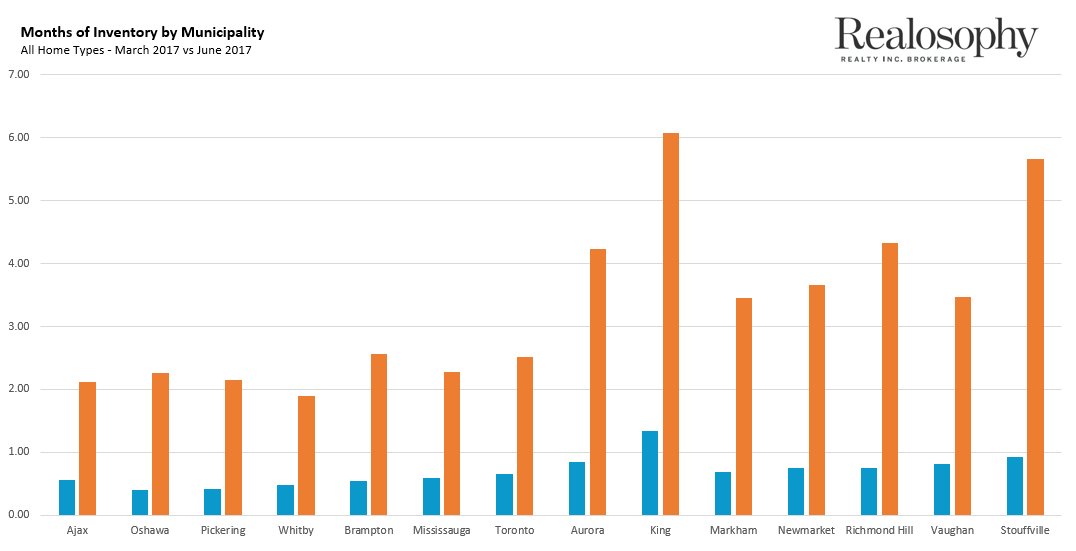
Meanwhile, the policies aimed at curbing rampant speculation in realty markets seem to be taking a hold in Ontario. This chart of months of inventory at the current rate of sales in Greater Toronto Area cities in June (orange) versus March 2017 (blue), offers a glimpse of rapidly changing supply dynamics.  What goes up on excessive credit, tends to mean revert just as aggressively.  Much more to come.

Posted in Main Page | Comments Off on Canadians using homes as ATMs

Why many kids can’t launch

The trend of 20 and 30 somethings returning to their parents’ home has been well noted for the past few years.  Frequently older generations will comment that today’s young seem to lack ambition or drive since they keep living with their parents.  Which misses a huge part of the equation here.  It’s not drive that’s lacking in most cases, it’s financial ability which is being impaired by some major macro factors.  To wit:

  1. Tight and competitive job markets (extenuated by slowing consumer demand in the west, automation, globalization and under-saved boomers living and working longer than past generations), mean that young people are required to have post-secondary education for most job opportunities.
  2. Post-secondary education costs are obscenely inflated relative to average income levels for most workers today (aided and abetted by the credit bubble and government-debt underwriting for education loans).
  3. According to government data, full-time students in Canada paid an average of $16,600 for post-secondary schooling in 2014–2015. That is more than $66,000 for a four-year program.  In my own experience the past two years, annual costs for full time students living away from home are more in the 25K a year price range–100k for a 4 year program.
  4. While 45% of Canadian parents surveyed say that they expect to help with their kids’ post-secondary education costs, most haven’t saved properly for it, and just 14% said they will cover more than 3/4rds of the expenses.
  5. In reality then, most kids are paying for all or most of their own education costs.  This means that most end up borrowing, and owing tens of thousands in debt when they graduate into weak job markets.
  6. Making matters worse, many young people in need of work and career experience today, are expected to work for free.   Ross Perlin, author of  “Intern Nation: How to Earn Nothing and Learn Little in the Brave New Economy,” estimates that of the million or so students doing internships, half aren’t being paid for their work and that includes college graduates according to U.S. News & World Report. [The Labour party in Britian has proposed to make free internships illegal.  More of this to follow].
  7. Lastly, the credit bubble of the past 15 years, has allowed housing costs to escalate far faster than wage growth.

All of this means that even where young people are able to successfully complete post-secondary education, most are coming out of school with huge debt obligations, into a weak labor market, facing low and sometimes non-existent wages, on top of ridiculous shelter costs.

So the next time that someone mentions a young person seemingly unable to support themselves, there is much to consider, including some blame to be shared among parents, top-heavy schools and policy makers.

There are no free lunches: debt-enabled price bubbles in education and housing end up costing all of us plenty, including kids that can’t launch and a loss of first-time home buyers, taxpayers and young workers to fund our social programs.  Perhaps now boomers should understand why kids are coming back like boomerangs and Why Millennials won’t be buying your house (at least not at these prices!)

Posted in Main Page | Comments Off on Why many kids can’t launch





