Greenback rebound stalks the risk trade (again)

After peaking a year ago at just over $102, the US dollar against a basket of global currencies sank to $89.20 in early January as the consensus predicted further dollar weakness and commodity strength.  Something else happened.  The dollar index has strengthened, while the CRB Index–a basket of 19 commodities (39% allocated to energy contracts, 41% to agriculture, 7% to precious metals, and 13% to industrial metals)– has lost its earlier momentum.

As shown in my partner Cory Venable’s chart of the CRB Index (below since 2006), a speculative financial frenzy drove commodities up 64% from October 2006 to June 2008 (left green band) before prices and interest rates relapsed with the economy into an extended recession and bear market (pink band).
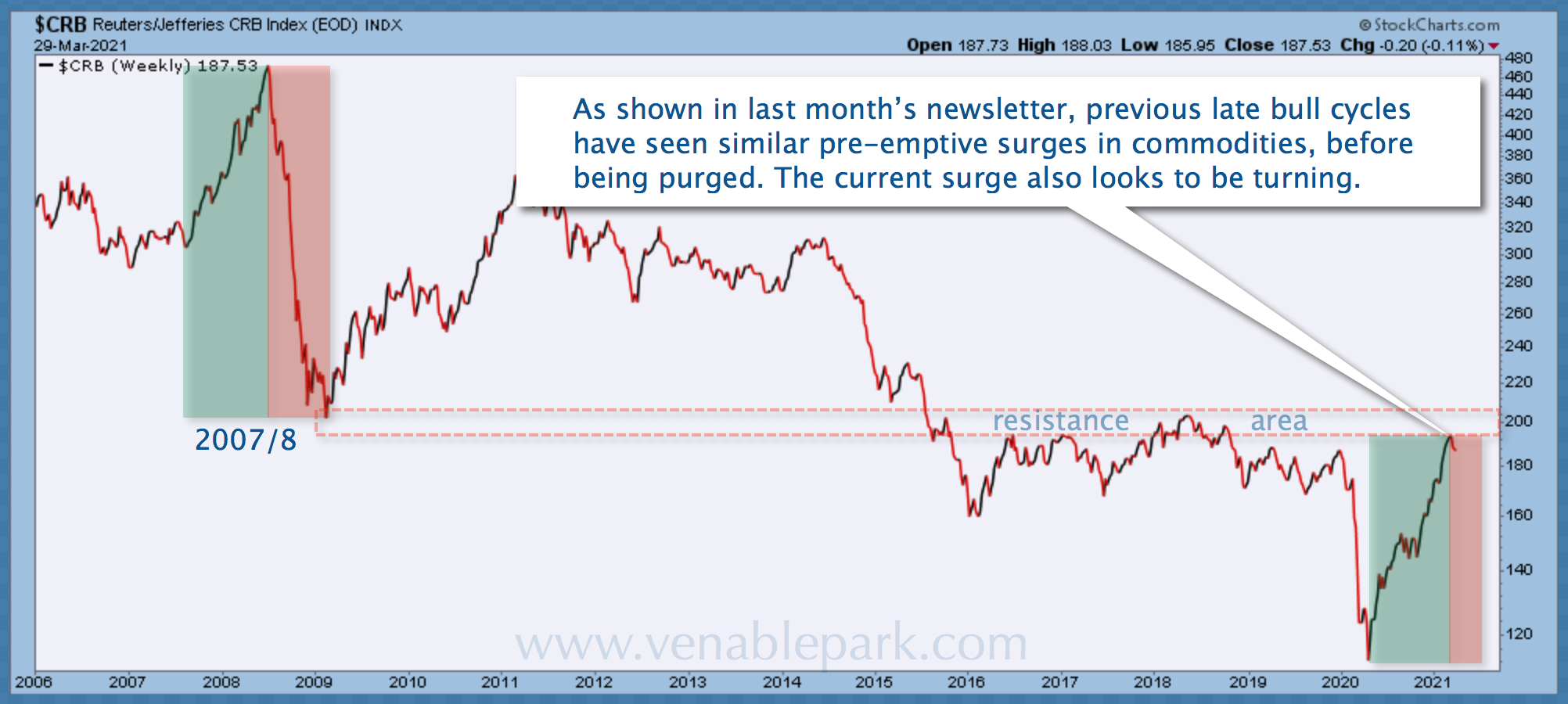

The long-established reality about high prices is that they encourage supply more than demand, and therein lies the seeds of their demise.

Time will tell if the commodity price top is in for this cycle or if further price pressure follows in the months ahead.  But with the CRB having already risen 94% between March and January 31, 2021, some robust demand hopes and infrastructure plans have surely been priced in.

The segment below offers a good (and dramatically articulated) market summary as we end Q1 2021.

This week Real Vision’s Roger Hirst uses Refinitiv’s best-in-class data to look at the cracks that have been appearing across the financial landscape after only a small bounce in the US dollar. Many of these issues will be dismissed as one-off events, unconnected by geography or asset. But they could all stem from cheap and abundant dollar liquidity that is showing increasing signs of sensitivity to a small reversal in the fortunes of the dollar. Turkey and Brazil have recently shown their vulnerabilities and the problems of leverage within a family office all represent risks that are lurking under the bonnet.

Here is a direct video link.

Posted in Main Page | Comments Off on Greenback rebound stalks the risk trade (again)

Four Reasons Wall Street is Wrong on Inflation

Longer-term government bonds are selling off, and their yields are rising, as commodity speculation and inflation expectations have leapt over the past seven months.  Central banks are throwing everything they have to maintain asset inflation because they cannot inflate wages, the necessary catalyst for sustained price inflation.  At the same time, leaping yields and commodities are the undoings of an ever-more indebted economy with non-replacement birth rates.  Therein perpetuates the deflationary circle that persists.

A. Gary Shilling’s latest Insight for April (behind paywall) is a deep dive into the underpinnings of inflation and deflation. For non-subscribers, some key points are summarized in the article 4 Reasons Wall Street Is Wrong on Inflation:

  • Americans will continue to save their stimulus money and pay down debt.
  • Wages are not rising sharply, and increasing commodity prices are temporary.
  • The increase in Treasury debt will be absorbed by investors and offset by an increase in consumer savings.

Also, see Ed Yardeni’s paper Four deflationary forces keeping a lid on inflation.

Higher yields are worse for debtors but better for savers as maturing cash can roll into higher-yielding deposits that rise in price when risky assets enter their next well-earned nervous breakdown.  Treasury bonds and cash preserve capital and liquidity for equity buying once highly levered markets are once more liquidating:

Shilling recommends that investors hold long-term Treasury debt. He also recommends shorting tech stocks and heavy holdings of cash.

Asked about what he’s waiting for to put his large cash allocation to work, Shilling said he’s “waiting to see if we get a blowup in the stock market.”

That could happen again to stocks that are attracting heavy speculative buying, like special-purpose acquisition companies and like GameStop and AMC did in late January. Those two stocks have since fallen sharply from their highs, though they remain well above their prices at the start of the year.

Shilling sees “inflation in those kinds of areas, not in spending for goods and services, which is a good reason there could be a major bear market in stocks.”

Posted in Main Page | Comments Off on Four Reasons Wall Street is Wrong on Inflation

‘Creative finance’ magnifies risks inherent in present market climate

This story hints at the fragility and solvency risks endemic in the current market climate.

Credit Suisse and Nomura are warning investors of significant losses after U.S. hedge fund Archegos Capital defaulted on margin calls. Here is a direct video link.

Of course, Goldman Sachs has never let criminal activity deter their profit focus.

Bloomberg’s Sridhar tar Natarajan has found out why and how Goldman Sachs Group Inc. made itself a player in the block trading saga. Here is a direct video link.

Posted in Main Page | Comments Off on ‘Creative finance’ magnifies risks inherent in present market climate