Hedgeye TV: facts that (still) matter in May 2020

Join Hedgeye CEO Keith McCullough and Danielle DiMartino Booth, former Fed advisor and Chief Strategist at Quill Intelligence, in this pro-to-pro investing discussion about the current market environment.

Here is a direct video link.

“In investing, the average consequences of risk make up most of the daily news headlines. But the tail-end consequences of risk – like pandemics, and depressions – are what make the pages of history books. They’re all that matter. They’re all you should focus on. We spent the last decade debating whether economic risk meant the Federal Reserve set interest rates at 0.25% or 0.5%. Then 36 million people lost their jobs in two months because of a virus. It’s absurd.  Tail-end events are all that matter.  Once you experience it, you’ll never think otherwise.”  –Morgan Housel, The Three sides of Risk, May 19, 2020

Posted in Main Page | Comments Off on Hedgeye TV: facts that (still) matter in May 2020

Retail participants going for broke (again)

Lockdowns and layoffs have given the masses both free time and a plunge in income over the past three months. This has led to a surge in gambling appetite, hoping to win money through online trading.  Last October’s switch by brokers to commission-free trades has helped to grease the mania even as custodians make hidden fees on credit balances and selling advance notice of their customer order flow to frontrunners.

It has always been the case that the public buys most at market tops and least near market bottoms.  According to data from the Financial Times, 780,000 people opened accounts with three of the four largest brokerages in the US: Charles Schwab, E-Trade, and Interactive Brokers year to date.

Besieged by click-bait and ‘how to play’ tips from the financial sales side, most participants will lose money as usual.  The trouble is, very few can afford to lose what savings they have left, and this makes our collective economic situation even more precarious. Worse, many are drawing on margin and other credit to fund their bets in financial suicide.

The overconfidence and ignorance of so many participants are writ large in chat rooms and comments on financial sites everywhere today.  This is familiar and foreboding. See  It’s a perfect storm of stupid in the stock market right now:

This herd of newbies has charged into the market at a time of incredible uncertainty. Hundreds of companies in the S&P 1500 have withdrawn their revenue guidance for 2020, leaving these new investors with little to go on in the way of forward-looking statements.

…In sum, what we have in the market is an unholy mess. We have bored, unseasoned, emotionally conflicted investors playing around in a murky pool where one of the most opaque sectors [vacinne development] has the ability to make the biggest waves. It’s very stupid — people are going to drown.

Posted in Main Page | Comments Off on Retail participants going for broke (again)

Bear markets bounce before they pounce some more

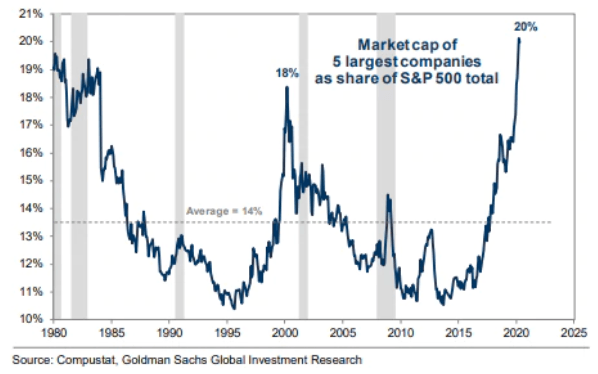
Historically, it is typical for the most widely held, over-valued stocks in a market cycle to have negative or zero returns for many years thereafter.  Today, the top five stocks in the S&P 500–Microsoft, Apple, Amazon, Alphabet (GOOGL), and Facebook–make up over 20% of the large-cap US index and 40% of the NASDAQ 100.

As shown below, this level of extreme valuation for the five largest companies surpasses even the fleeting tech-wreck top of March of 2000, whereafter a 78% decline in the tech sector helped the S&P 500 lose 50% of its value.

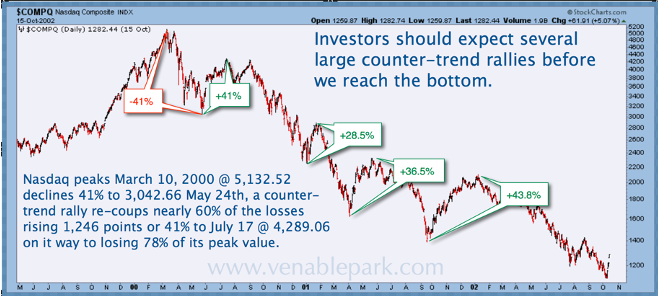
Since March 23, free-flowing funds from governments and central banks have driven a resurgence of animal spirits in market participants and the US stock market has led the world in a price bounce.  As shown in my partner Cory Venable’s chart below of the NASDAQ index from March 1999 to October 2000, very similar price action came after the first 41% drop from March to May 2000 as stocks staged the first of four 28 to 43% rebounds, during their 2.5 year mean-reversion journey back to reality.

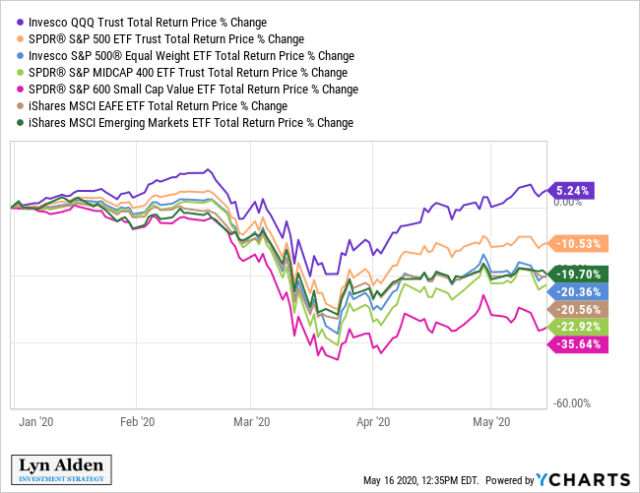
As shown below, today it is once more the NASDAQ 100 (QQQ) index leading the bounce to reclaim a 5.24% gain year to date.  At the same time, other economically sensitive small and medium cap companies as well as emerging markets and Europe, Australasia, and the Middle East (EAFE) shown below remain moribund and deeply negative.  See First Liquidity, Then Solvency.

The biggest tech darlings are overloved and concentrated in most funds and portfolios today.  This is likely to hurt returns from here.  It was not until June 2015–more than 15 years later–that the NASDAQ 100 reclaimed its March 2000 peak.  By then, most of the original holders had long since liquidated in losses.  This time is unlikely to be different.

There is no sign that the 2020 bear market has ended yet.  Buy and holders beware.

Posted in Main Page | Comments Off on Bear markets bounce before they pounce some more