
High fees and risky bets not in best interests of Canadians

Andrew Coyne points out some startling figures about the Canada Pension Plan on which the majority of Canadians depend for retirement income.  See Canada Pension Plan gets lucky with active management, for now. Here are some key takeaways:

  • Switching to a new ‘active’ management strategy in 2006,  the number of Canadian Pension Plan Investment Board (CPPIB) employees has risen tenfold over the last 13 years (from 164 in the year ended March 31, 2006, to 1,661 in fiscal 2019).
  • Transaction costs and management fees are now 17 and 44 x what they were under passive management.  Operating costs, at $1.2 billion, are now 22x what they were in 2006 — 5x as much, relative to assets.
  • Total annual costs have risen 28x from $118 million to $3.3 billion annually (or from 0.12% of assets to 0.83%).
  • For all of this, the CPP says that it has beaten a “reference portfolio” of stock and bond indexes — by an average of 0.6% annually since 2006.
  •  While the CPPIB holds 56% of its portfolio in equities today, these are predominantly private equity, real estate and infrastructure projects which are less liquid than market assets and considered thus risk-equivalent to an 85% weight in equities, up from a 65% equivalency in 2015.

As always, there’s no free lunch.  The plan’s high risk-exposure also sets it up for higher than market losses in the next downturn, just as more and more retirees are applying for pensions, and fewer workers are paying into the fund. The critical importance of stable pensions and reliable payouts was the very reason that some 96% of public pension assets were held in fixed-income bonds and cash into the 1950’s, with strict limits on the amount of risky bets permitted (Federal Reserve’s US Financial Accounts).

As I’ve pointed out in the past, the fact that one may win at gambling for a given period does not make it a legitimate or prudent investment strategy.  Coyne comes to a similar analogy:

“Suppose, as an alternative scenario, the CPPIB’s managers had bet the fund on the fifth race at Woodbine, and suppose their their horse had won. It wouldn’t mean either that betting on the horses was a good investment, or that the CPPIB knew how to pick horses. It would just mean they got lucky…

Will it still be ahead of the game 13 years from now? We shall see. But by then the money will have been spent, and the managers paid, and it will be too late to ask for it back.”

High operating costs and risks do not bode well for the Canada Pension Plan’s promise to an aging, under-saved population; nor for Canadian taxpayers and a consumption-driven economy.  It will no doubt need restructuring to defer retirement ages by several years as well as increase funding in the years ahead.  All will be difficult for Canadians to afford.
Posted in Main Page | Comments Off on High fees and risky bets not in best interests of Canadians

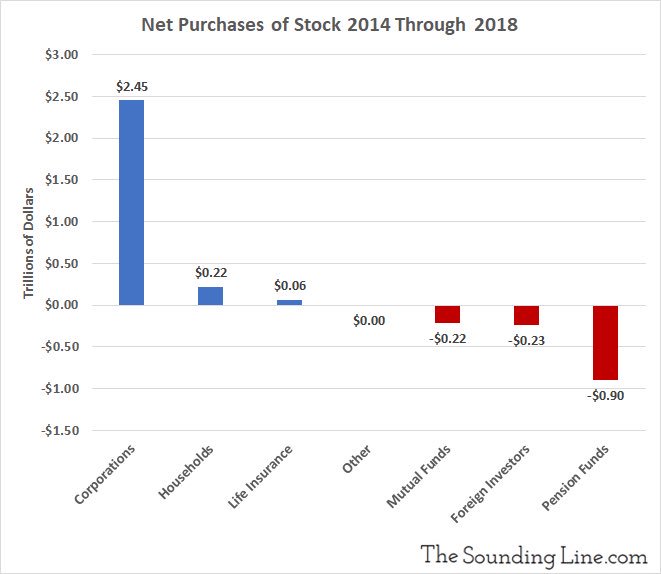
Corporations biggest net buyers of stocks since 2014

Who in the world has been buying stocks at increasingly speculative-grade valuations over the past five years?  As charted below, the biggest net buyers have been public corporations themselves as management used liquidity driven by central banks to buy back shares and drive their prices higher.

Not only has the activity fabricated the majority of paper earning gains and diverted funds from critical areas like operations, R&D and capital investment, but many companies have borrowed heavily to do so, and thus depleted their strength and opportunity fund for meaningful investment in the years ahead.  There is a reason that corporate earnings are a historically mean-reverting series;  this time will not be different.

It’s been a lucrative short-term strategy for executives who have sold their personal holdings into the flow created.  But it’s also a blatant conflict of interest in their duty to broader company stakeholders like employees, creditors and others counting on the viability and sustainability of the company’s operations longer-term.

As share prices plunge, and profits retreat in the downturn, the folly of so much wasted capital will be widely evident once more.  Individuals and pensions that have been riding corporate buyback flows, through increasing equity exposure, and confusing rising prices with investment acumen in recent years, are also due for a harsh awakening.

Posted in Main Page | Comments Off on Corporations biggest net buyers of stocks since 2014

US Recession already started? Beware ‘defensive’ stocks

Economic weakness is already global and very likely to be measured as recessionary in backward-looking assessments months hence. Falling revenues globally are intensifying a cash crunch and drawing capital flows out of emerging markets and currencies and into the most liquid assets such as treasuries and US cash. This is typical during global downturns, and especially when the world is encumbered with high levels of U$ denominated debt, as it is today.

For Canadians, an allocation in investment portfolios to the US dollar can be a rare place to make a capital gain on currency when other risk assets are falling. A practical caveat, however, is that it’s still prudent to keep the bulk of our savings in the currency in which we pay the bulk of our expenses. If most of our expenses are in loonies, then it is defensive to keep the majority of our funds in Canadian denominated assets even when the currency is weakening as against the greenback.

Another point to keep in mind is that once bear markets begin, all risk assets–commodities, corporate bonds and equities–dividend paying and not–tend to fall in value together. Suggesting that one hold consumer staples, or pipelines, utilities or financials as ‘defensive’ sectors, is code for saying that ‘defensive’ sectors or companies still go down in bear markets but any dividends received (3 or 4%) will help to lessen the overall loss incurred (ie., -25% capital loss -4% dividend received is a 21% loss rather than 25%).

While this may sound good in theory, in reality, dividends are woefully insufficient compensation for the losses and trauma experienced. This is particularly so, when people are withdrawing dividends received as income and so there is no reinvestment of them into cheaper shares as prices fall. It is very little understood that the historic compound returns widely quoted for equities, all assume that dividends are not spent on fees or withdrawals but perpetually reinvested into more shares every quarter. In reality, this is almost never the case, and certainly not once people are taking regular income withdrawals. This is one of the reasons that most people dramatically underperform historic returns advertised in equity marketing materials.

The other reason for broad underperformance in real life is that, in theory, no one sells after bear market losses but rather uses clearance sales to redeploy cash on the sidelines. In reality though, since the majority buys most near tops and goes over the bear market edge fully invested, they have no meaningful cash to deploy near bottoms. Indeed, most sell at the bottom to raise cash and thereby miss the most valuable buying opportunities of the cycle. This is why most dramatically underperform optimistic return targets over time.

With all of these additional caveats, our own cycle assessments are broadly in line with economist David Rosenberg’s as he expresses them in the segment below.

The world’s biggest economy is already in a recession, according to prominent Canadian economist David Rosenberg, who says the U.S. Federal Reserve will begin cutting interest rates all the way back to zero starting this summer. Here is a direct video link.

Here is a link to part 2.

Posted in Main Page | Comments Off on US Recession already started? Beware ‘defensive’ stocks





