Two decades of monetary largesse are the harm not the cure

The US Fed has led the world in 20 years of progressively more extreme monetary interventions to inflate debt and asset prices at all costs.  Each time that US stock markets have dropped more than 10%, central banks have moved to ‘ease’ volatility with more and longer monetary ‘accommodation’.  Nevertheless, in both 2001 and 2007, despite slashing some 5% off benchmark interest rates, recessions arrived, and stock and corporate bond prices fell by half.

It took a drop of just 14% in the S&P 500 in 2018 for the US Fed to switch from telegraphing rate hikes through 2019, to promises of further patience and pause.  Not satisfied, many market participants are already calling for central banks to abandon ‘normalization’ goals and switch back to cutting rates and ‘supporting’ asset buying once more.  See The Fed’s “First do no harm” policy is harmful from Economic Cycle Research Institute’s Lakshman Achuthan to wit:

“Removing the risk of a recession and sparking a renewed acceleration in economic growth – never mind reigniting inflation pressures – will require much more than the doctrine of primum non nocere, meaning first, do no harm. The Fed would actually need to start a rate cut cycle.”

At the same time, Achuthan acknowledges that the global slowdown now underway is an overdue part of the cycle, set to continue for many months, no matter what the Fed does next:

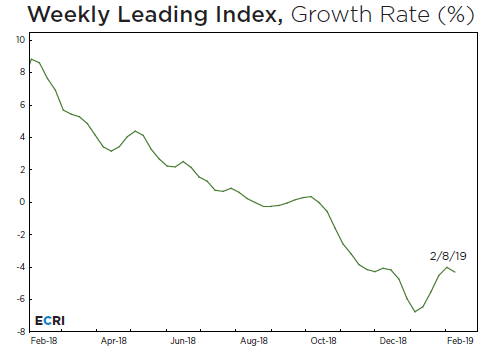
The problem is that, regardless of what Powell has said, the cyclical drivers of economic growth continue to wind down, meaning that the slowdown is set to continue. That’s the objective message from the same array of leading indexes that we used to predict the current U.S. economic slowdown in the context of a global slowdown last year. A case in point is the publicly available U.S. Weekly Leading Index, whose growth rate remains in a cyclical downswing.
The fact is that in always wanting to accommodate further debt and risk-taking, central banks have inflicted great harm on the world economy, financial strength, and stability.  Politicians and sales firms have urged them to do it, to be sure, and consumers commonly fail at personal discipline, but the actors at central banks are supposed to be the impartial, prudent experts working to smooth economic cycles so they are less damaging as a whole.  In this, they have failed utterly.

I have zero faith that central banks will change course now.  I also understand that the downcycle is due even as central banks attempt to ease further in the months ahead.  Policymakers have failed in their mandated duties of care and control.  Like children who realize their caregivers are not up for the task, individuals must look out for their own best interests.


Posted in Main Page | Comments Off on Two decades of monetary largesse are the harm not the cure

The fish ‘business’ is vanishing

Plastics, pollution and over-fishing have already eradicated most large sea life.  At this point, we are either a person making active choices to help reverse the destruction or we are not.

James Blunt is best known as a singer, but he’s also an outspoken advocate for ocean conservation. Blunt sat down with Jim Edwards, editor-in-chief of Business Insider UK, to discuss why he’s campaigning for sustainable fishing and why he is a spokesperson for the Blue Marine Foundation.  Here is a direct video link.

Posted in Main Page | Comments Off on The fish ‘business’ is vanishing

Sponsored-media and the dangers for consumers

I have been writing for years on the perils for consumers of media and investment conferences sponsored by financial sales firms and their representatives.  While the costs were writ clear in the 2008 financial collapse, the lack of will to separate financial sales from advising, or prosecute large institutions for ongoing fraud and reckless activities since, have enabled an intensification of dangers.  CBC Go Public investigated one such example recently in ‘Fake’ experts on radio shows conned listeners out of millions, experts say:

The case highlights the increasingly blurred line between programs that sound like news but are actually paid advertising, and how disclaimers often do little to inform audiences of the difference, says media ethicist Stephen Ward.

“The whole area of paid content is an ethical quagmire … Cases where it’s blurred cause false stories,” he said.

In this case, ‘foreign exchange experts’ were regularly featured on at least five local radio stations — owned by Corus Entertainment and Bell Media — that ran in southern Ontario between 2016 and part of 2017.  These actors were allegedly outright fraudsters paying to appear as expert guests and then stealing customer deposits for their own use.

That said, financial sales representatives buying spots that are then delivered to the public as valuable insight goes far beyond this case.  Bloomberg, CNBC and BNN are all based on this heavily-conflicted model.  And, as I wrote in 2011, the CBC and other long-standing news outlets have also succumbed to some of these revenue-focused tactics over the last 15 years, see CBC television degrades itself, as well as O’Leary not admirable or worthy of leadership.

The bottom line is that media and media personalities tend to have a larger-than-life influence on viewers and listeners, buyers need to be very wary.

Posted in Main Page | Comments Off on Sponsored-media and the dangers for consumers