
Clawbacks of ‘hot flows’ coming after international land banks

Now that China is struggling with slowing growth, massive debt and an aging population, a hunt to recover funds siphoned out of the country over the last decade has begun in earnest.  Clawbacks can drive forced selling of property in previously ‘hot flow’ countries like Australia and Canada, just as domestic demand in these markets is also weakening.  International inflows helped to drive property prices far above reason over the past decade, and their outflows will help to drive prices back down.  This is likely to compound stress on other owners and lenders who are highly levered in these markets.

As China transforms into an economic powerhouse, billions of dollars have been illegally spirited out of the country. Mark Willacy reports on the bounty hunters chasing China’s missing millions in Australia. Here is a direct video link.

Posted in Main Page | Comments Off on Clawbacks of ‘hot flows’ coming after international land banks

Corporate policies helping to drive extreme wealth disparity

CNBC’s Bob Pisani talks with Paul Tudor Jones, founder and CIO of Tudor Investment, about socially-responsible investing and the U.S. market. Here is a direct video link.

Tudor Jones: We have a mania going on in buybacks from CNBC.

Posted in Main Page | Comments Off on Corporate policies helping to drive extreme wealth disparity

Debt crisis demands new thinking, policies and behavior

The true source of widespread financial instability today is rarely acknowledged by mainstream commentators and their sponsors.  Former Senator Heitkamp’s comments on CNBC this week were an exception, see:  A tax alone won’t fix the wealth-income gap.

The fact is that we are in the midst of a debt crisis globally.

This has been compounded by corporations, politicians and debt-sellers who never want to see near-term consumption decline and debt fall so that savings can rise.  Because people are carrying so much debt, it makes it very hard to save for retirement and other goals.  To fix what ails households and the economy, we need to forego some present consumption and near-term corporate profits.  Monetary and government policies have encouraged debt creation and financial speculation over the last 30 years at great expense to savings and capital preservation.  These policies must be reversed.

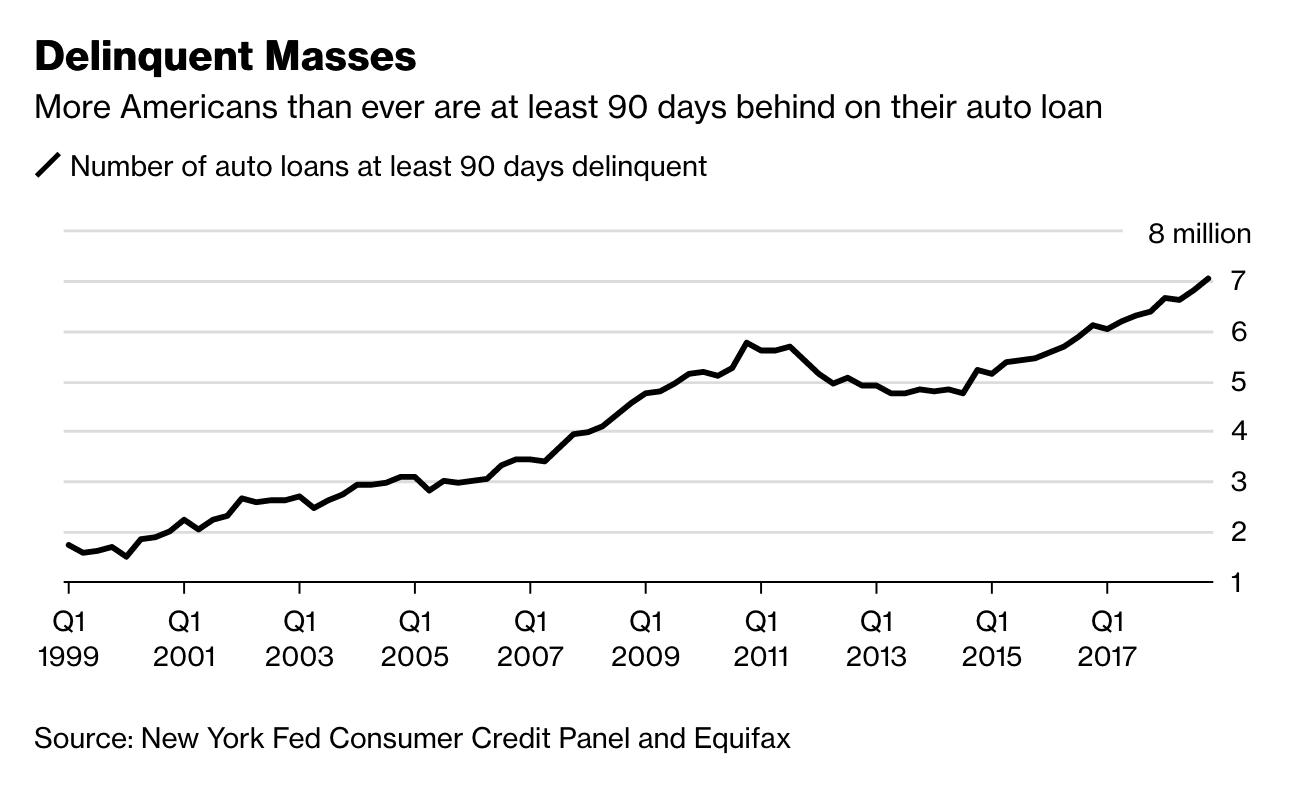
Further to this point, the Federal Reserve Bank of New York reported this week that more than 7 million Americans were at least 90 days behind on their car loan payments in the fourth quarter of 2018 (chart below).  This is more than in the 2008 recession when unemployment was a cycle highs.  Today, we have record loan delinquencies while the unemployment rate is near a record low.  This gives a sense of the economic vulnerability that years of debt abuse have now wrought, see  Why the Fed is treading so lightly even in a ‘booming’ economy.

Posted in Main Page | Comments Off on Debt crisis demands new thinking, policies and behavior