
Changing menus to support health

In the wake of more studies connecting childhood obesity to a scourge of chronic health problems and shorter lifespans, transforming the food we are offering children and adults has never been more critical:

“Large parts of the population believes that when you have problematic genes it is game over…We have discovered that it does not matter whether the children and adolescents have an increased genetic risk score or not…our treatment [using dietary and lifestyle changes] is efficient despite carrying common obesity risk genes. It gives hope to people with obesity and obesity related complications such as high blood pressure, cholesterol and fatty liver that we can in fact help them.”

Knowing that diet based-illnesses compound as we age, if we say we are too busy to prepare healthful food, the question has to be:  how can anything be more time worthy?

Audrey is the CEO of Balanced, a nonprofit aimed at making healthy food more accessible in workplaces, schools, hospitals, universities, and retail spaces across the country. Formed in collaboration with leading nutrition expert, Best-Selling author, and founder of NutritionFacts.org, Dr. Michael Greger, Balanced was created to help end the ongoing public health crisis that is associated with the overconsumption of unhealthy foods.

Posted in Main Page | Comments Off on Changing menus to support health

Recession due? Stocks are not ‘defensive’

David Rosenberg can be helpful because he is one of the few economists who looks for negative trends in the data rather than just blue skies and sunshine.  His comments on the implications of a ‘Powell pause’ in this clip are lucid.  Here is a direct video link.

This ‘elephant in the room’ could send stocks into a tailspin, Wall Street bear David Rosenberg warns from CNBC.

Incongruent, however, is that while warning of late cycle recession risks and a housing downturn in Canada, Rosenberg was suggesting people move capital into Canadian stocks this month.  True, Canadian equities are trading at cheaper valuations than US stocks today, but they are still near cycle highs, and stocks are stocks–they pretty much all tank in recessions and bear markets.  ‘Defensive’ they are not.

Even in 2001, when Canada did not officially follow the US into recession, the Canadian stock market still lost half of its value along with US markets.  A similar magnitude of losses happened in 2008, even though Canadian realty was then much less levered and more stable than US housing.  Of course, that was then, today Canada is worse off.

Rosenberg’s firm Gluskin Sheff,  a Canadian-based asset manager, may expect their chief economist to talk in support of their Canadian equity holdings.  This would be unfortunate because Gluskin hired Rosenberg to come and help rehabilitate their risk-management image after their portfolio losses in the 2008 cycle.  Given that Gluskin’s own share price (GS.TO) has fallen 50% since 2014 and 35% since just July, it seems the firm is under pressure once more.  Unfortunately, remaining long and adding to Canadian equity positions, heading into a recession, is unlikely to help them or their clients.  But since most asset management firms are paid the highest fees from equity allocations, this tends to be a constant mantra.

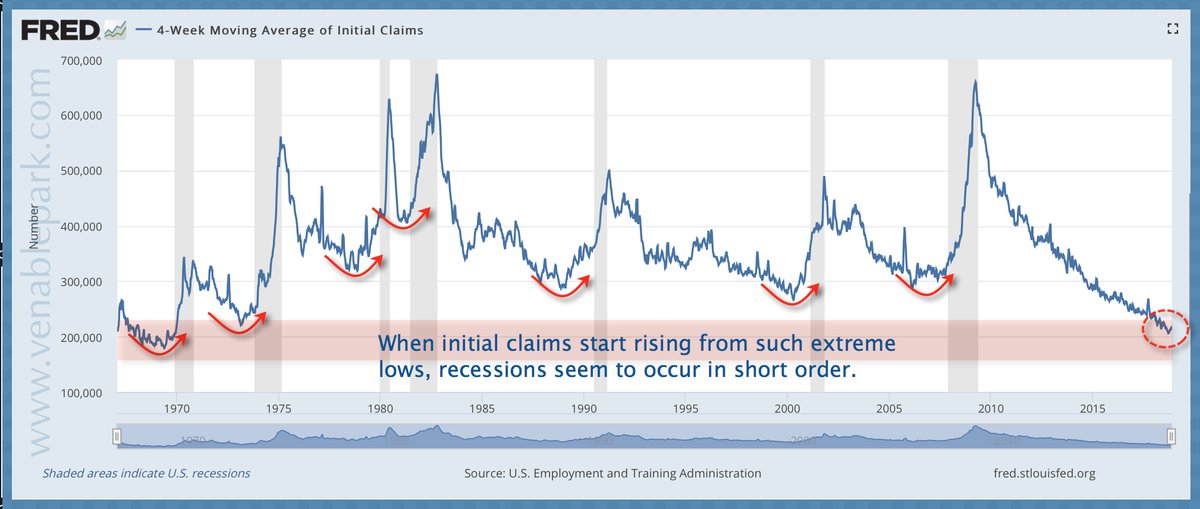
Further on cycle point this morning, US initial claims for jobless benefits moved higher.  As shown in my partner Cory Venable’s chart below since 1965, when initial claims start rising from extreme lows, recessions (grey bars) have historically been imminent.

Posted in Main Page | Comments Off on Recession due? Stocks are not ‘defensive’

UN: ‘Governments must stop subsidizing fossil fuels’

Another day another urgent warning on climate catastrophe, this time from the UN, see World must triple efforts or face catastrophic climate change:

“New taxes on fossil fuels, investment in clean technology and much stronger government policies to bring down emissions are likely to be necessary. Governments must also stop subsidising fossil fuels, directly and indirectly, the UN said.

Gunnar Luderer, one of the authors of the UN report and senior scientist at the Potsdam Institute for Climate Impact Research in Germany, said: “There is still a tremendous gap between words and deeds, between the targets agreed by governments and the measures to achieve these goals.

“Only a rapid turnaround here can help. Emissions must be reduced by a quarter by 2030 [to keep warming to no more than 2C (3.6F) above pre-industrial levels] and for 1.5C emissions would have to be halved.”

Business–as–usual is the road to economic ruin.  Meanwhile a growing wave of lawsuits for damages caused will continue to plague the companies, leaders and individuals who perpetrate and enable the status quo.  Who of us is making active steps and daily choices now to lead the change needed?

Posted in Main Page | Comments Off on UN: ‘Governments must stop subsidizing fossil fuels’




