
Stocks surge on news economy too weak to raise rates as hoped

We have been noting all year, that central banks were unlikely to hike their policy rates as hoped because economic weakness in the highly indebted global economy would cause them to pause, and then return to another round of accommodative experiments.

As I wrote here last week in Nearing the Pause that Won’t Refresh? every business cycle central banks optimistically hike rates with the stated goal of slowing the economy enough to prevent it from overheating and not so much as to trigger a recession.

And even though they have failed in this goal 12 of the last 13 tightening cycles, with a recession and bear market following all but one in the mid-1990s, hope springs eternal.  This chart shows the rate-hiking pause that preceded the last two recessions in 2001 and 2008 (grey bars).
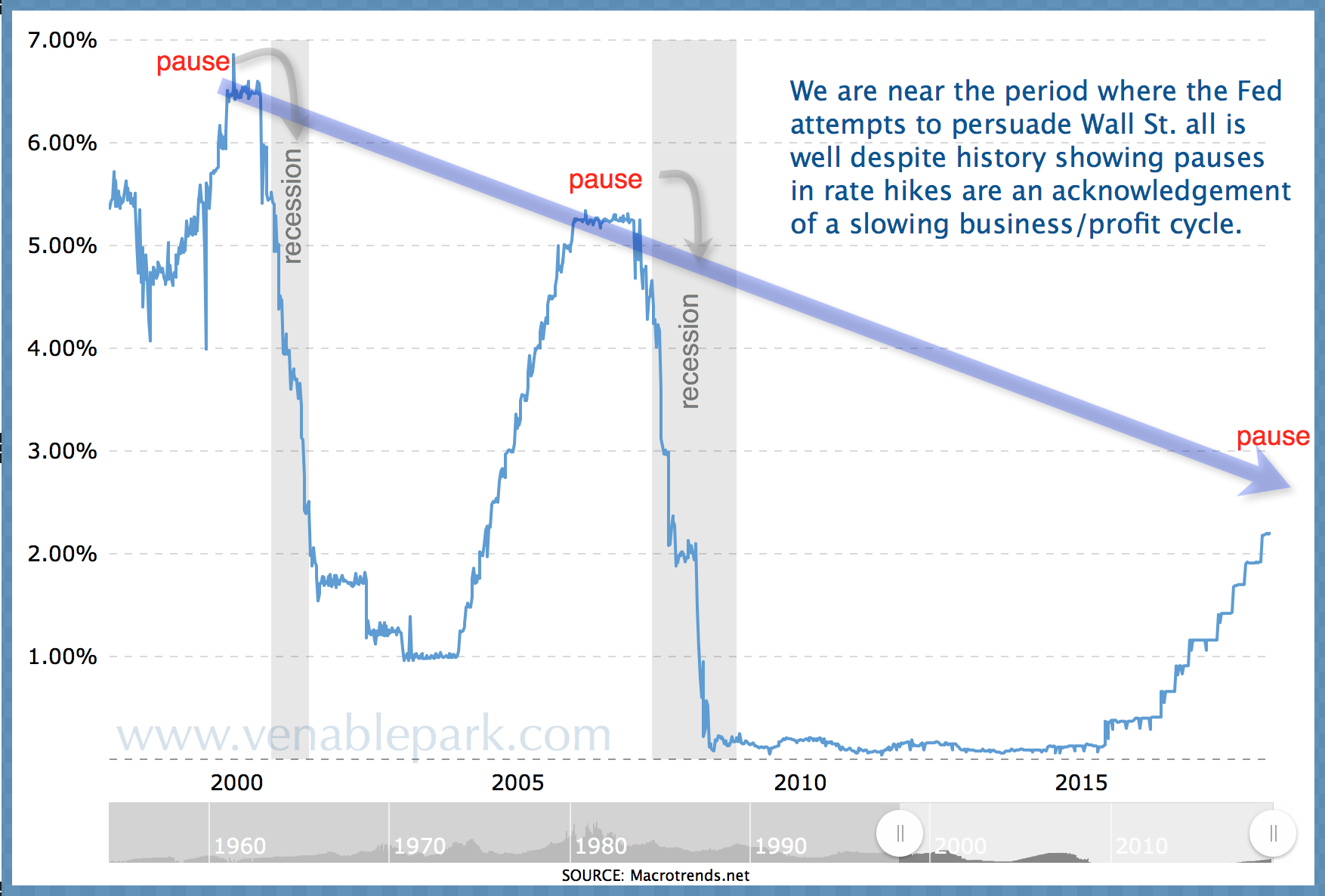

It is typical for stocks to respond to pause news with initial jubilation, even while government treasuries are bid, and oil makes a 2018 low today. Only the latter two are admitting the vector of growth here. In a co-dependent dance, the more stocks rally at this point, the more likely the Fed will see room to hike further and therein lies the crimp of debt burdens amid falling cash flows.

After the initial surge of exuberance comes a revelation that central banks are eyeing a pause because profit margins are shrinking and the economy and market cycle have already rolled over.  If history holds, next comes a reality phase, when the cash crunch intensifies among highly levered participants, and asset liquidation resumes with full vigour.

Posted in Main Page | Comments Off on Stocks surge on news economy too weak to raise rates as hoped

Housing bubble popping again?

Home prices are precarious to a deflating debt cycle in the US, Canada, Austrailia, New Zealand, the UK, Hong Kong, Sweden, and…well pretty much everywhere that humans have used excessive debt to drive up realty prices far beyond income growth over the past decade.  See:  The U.S Housing Boom is Coming to an End, Starting in Dallas for some good stats and charts.

We have to live somewhere.  Homes that one can carry for the same or less than the price of rent can be great foundational assets to have.  But the goal should always be to get it paid for as soon as possible and to keep other carrying costs well below our means.

A paid for home or office with income generating units within it that help cover the owner’s carrying costs, even create net cash flow–even better.  But using debt to acquire real estate that makes us cash poor or cash-flow negative is generally a bad financial decision that usually ends in trauma.  To prosper from bursting asset bubbles, we need to have low or no leverage personally, with liquid cash and our buy list, and then patiently wait for prices to go on clearance sale.  They always do in the end.

As we’ve been tracking here at PeakProsperity.com, the housing market is starting to look quite ill. After the central bank-driven Grand Reflation following the Great Financial Crisis, home prices are now beginning to nose over from their new bubble-highs. Has the Housing Bust 2.0 begun? If so, how bad could things get? And what steps should those looking to pick up values at much lower prices in the future be taking?

This week we talk with citizen journalist Ben Jones, property manager and publisher of TheHousingBubbleBlog — where he tracks the latest headlines and developments in the housing market. And given the stream of data Ben sees every day, he’s extremely pessimistic on home prices in most major markets worldwide. Here is a direct video link.

Posted in Main Page | Comments Off on Housing bubble popping again?

More on why product sales must be separated from financial advising

Financial sales firms will never ‘get’ the sacrosanct importance of holding professional advisors to a fiduciary standard because masquerading sales as advising is such a lucrative business model for them.

The crash of 1929, the decade of loss and suffering thereafter and the revelations of the Pecora Senate hearings of 1932-34, made this vividly clear to our grandparents and led to the landmark Glass-Steagall Act of 1933 and its hard divisions between banking, product underwriting and advising services, as well as the Securities Act of 1933 setting penalties for filing false information about stock offerings, and the Securities Exchange Act of 1934, to regulate stock exchanges.  This was all watered down to nothing over the past 20 years, and the consequences are our present reality of record debt, destabilizing financial risks and gaping capital shortfalls in most of the world’s pension, trust funds, families and institutions.

A recent article underlines the classic conflicts of interest so endemic today in Some Merrill Brokers say plan urges more consumer debt:

Some brokers at Merrill Lynch are pushing back against a compensation plan they claim rewards them for increasing debt their clients take on and in some cases can punish them for reducing it.

…The skirmish is occurring as brokers digest pay policies that include what amounts to a broad pay reduction as well as changed targets for attracting new business and cross-selling certain products. Those who miss growth targets earn less than in the past; those who jump certain hurdles stand to get a bonus.

One of those targets focuses on growing clients’ net new assets and liabilities, including things like securities-backed loans and mortgages, by at least 2.5% annually…

Loans that are backed by a client’s investment portfolio are a particular favorite of brokerage firms, said Jeffrey Harte, brokerage analyst at Sandler O’Neill + Partners. “It’s taking money that’s already there and making more money on it, versus the much harder job of going out and growing assets,” he added.”

Merrill Lynch Wealth Management ‘Manglement’ head Andy Sieg is so corrupted that when asked about the scheme, he didn’t even know to be embarrassed about it, acknowledging some complaints from brokers he added the “pay program has motivated many financial advisers and helped boost growth at Merrill.”

Well, if it’s helping boost growth for the brokers and your bonus Andy, by all means, abuse away, right?

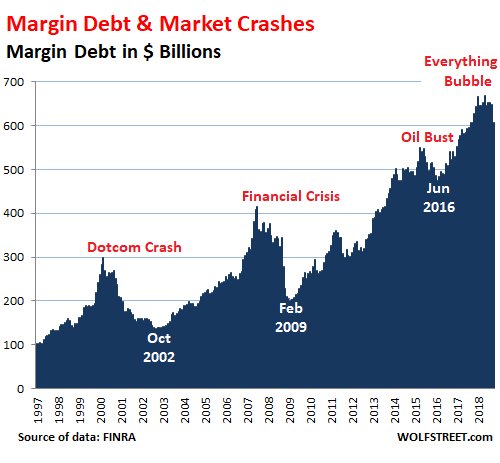
The add more debt and stir model has been legendary this cycle. Below is the latest margin debt chart showing funds borrowed against security portfolios from 1997 through the end of October.  Much forced selling is coming to markets everywhere as these levered accounts unwind amid falling prices.  And that won’t just hurt levered participants, but un-levered ones who think they are being ‘conservative’ as well.


Posted in Main Page | Comments Off on More on why product sales must be separated from financial advising




